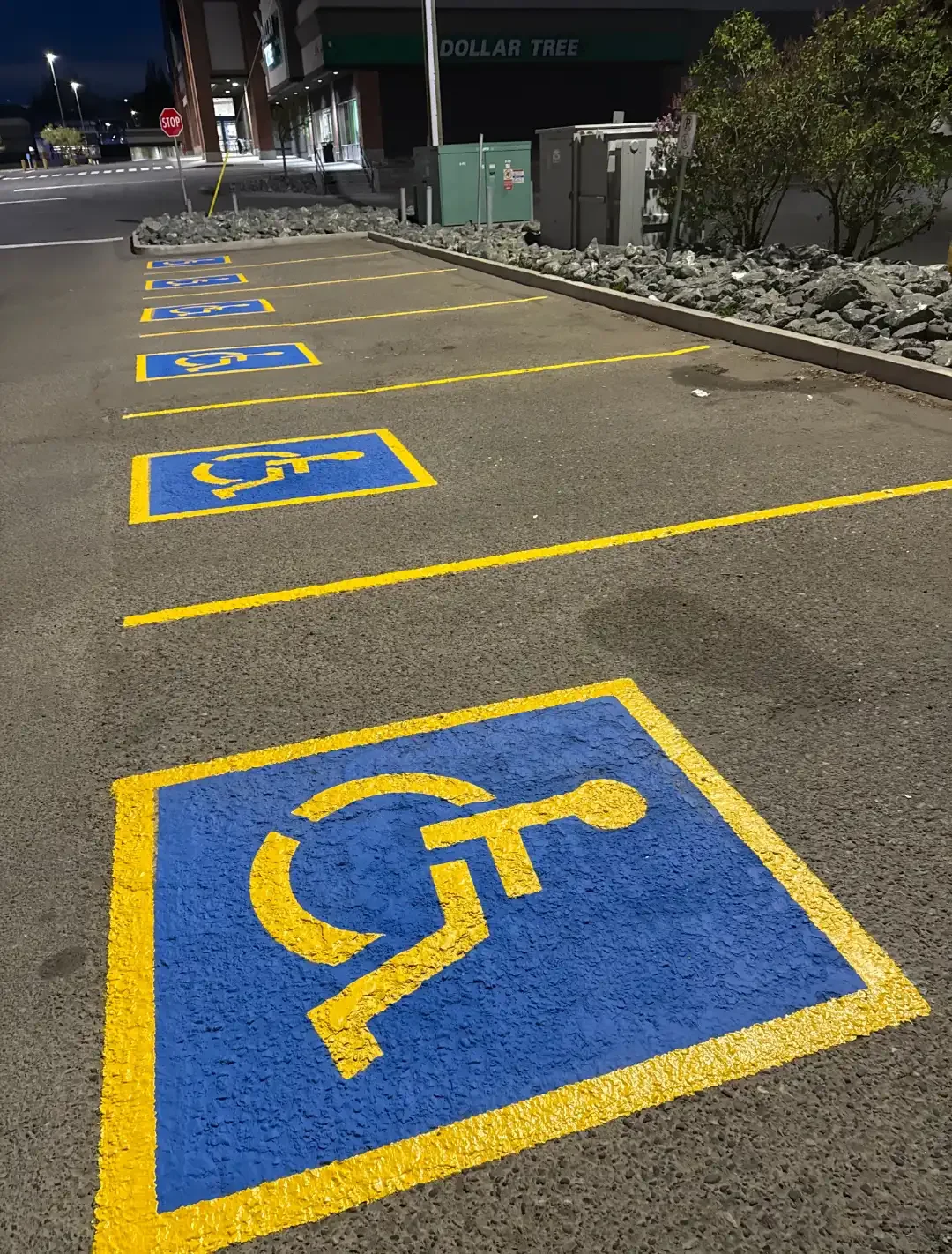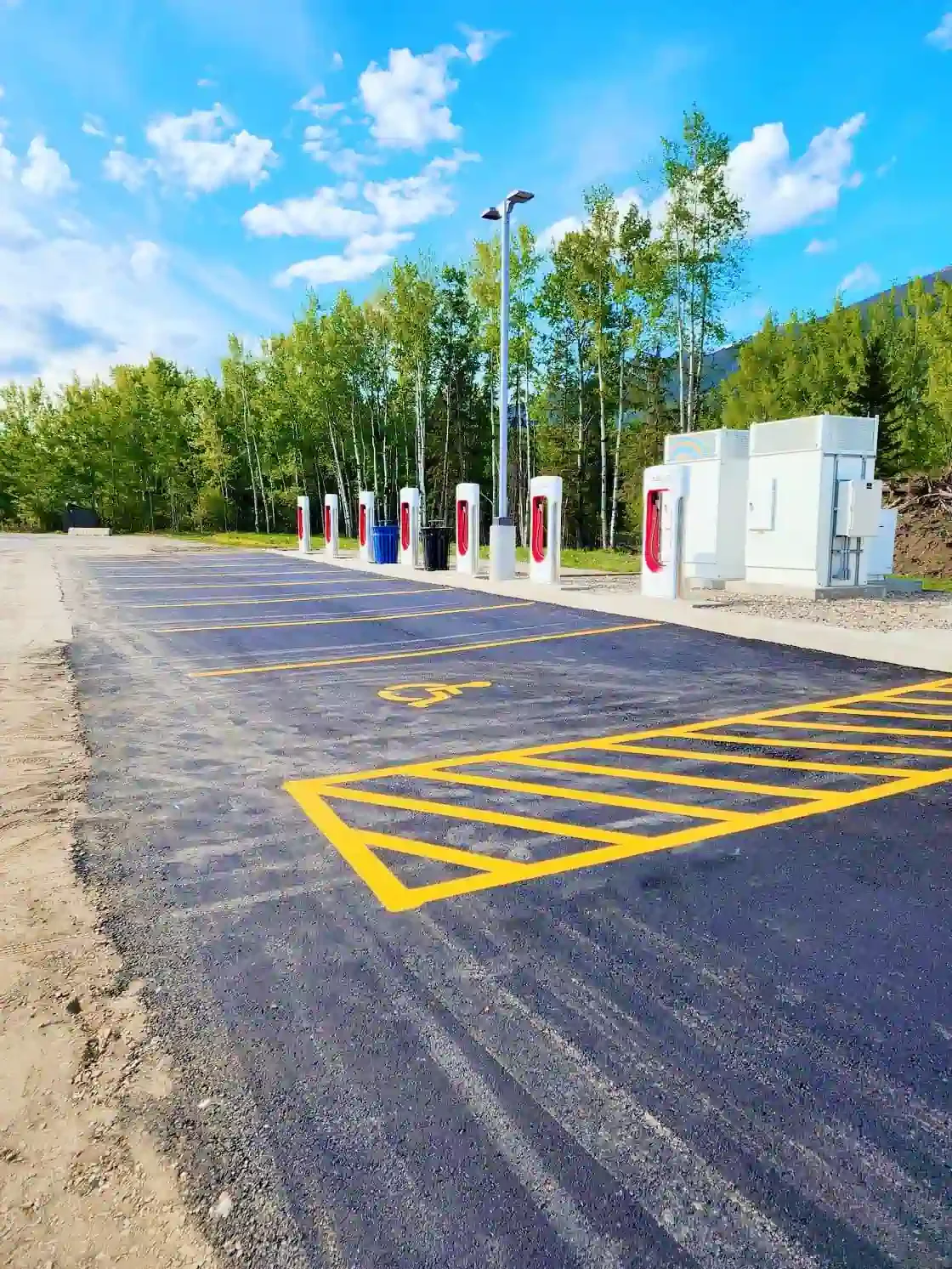
Project Highlight: Parking Lot Line Painting at the Tesla Supercharger Station in McBride, BC
By Dennis Kuebler, Founder & Owner, Epic Pavement

Project Snapshot
Project: New parking lot layout, line painting, accessibility markings, and pavement marking
Location: Tesla Supercharger station, Petro-Canada, 795 Bridge Road, McBride, BC
Completed: Late May 2024
Station opened: Early June 2024
Scope: New layout for fast-charging stalls, accessible parking with hatched access aisle and ISA symbol, directional flow, beaded reflective traffic markings
Equipment: Professional-grade airless line striper with laser-guided layout, industrial stencils, MPI-spec waterborne acrylic traffic paint with reflective glass beads
Epic Pavement is a Prince George, BC-based pavement marking and asphalt maintenance company serving Central and Northern British Columbia. Founded by Dennis Kuebler in 2023, we focus on parking lot line painting, line striping, accessibility markings, asphalt repair, crack filling, parking lot sweeping, and snow removal for commercial, industrial, and residential properties.
The drive from Prince George out to McBride is one of those drives that reminds you why you live in this part of the country. About two hours east on Highway 16, you follow the Fraser River up through the Robson Valley with the Cariboo Mountains on one side and the Rockies starting to rise on the other. By the time you roll into McBride, you've left the highway noise behind and you're in a small village where the gas station is the meeting place for half the people passing through.
That gas station — the Petro-Canada at 795 Bridge Road — is exactly where this project lived. In late May 2024, Epic Pavement laid down the parking lot lines, the accessible markings, and the hatched access aisle for what was about to become the new Tesla Supercharger station for McBride, BC. A few days after we packed up, the station officially opened to the public in early June. It was the only fast-charging stop on a long stretch of highway between Prince George and Jasper, and for EV drivers heading across the country, it instantly became one of the most important charging points in northern British Columbia.
This is the story of how that lot came together — what we used, why it matters, and the kind of details we sweat on a job like this.
Why a Tesla Supercharger Lot Is a Different Kind of Line Painting Job
I've painted a lot of parking lots. Retail. Apartment complexes. Industrial yards. Each one has its own quirks. But an EV fast-charging station is its own animal, and if you're not thinking about it differently, you'll get it wrong.
A few things make a charging station lot tricky:
The stalls are wider than a regular parking spot. Tesla Superchargers need extra room because drivers have to swing the cable from the post to the charge port — and the port location varies depending on the model. A standard 8'6" stall doesn't always cut it. You're typically looking at 9' to 10' wide minimums with the stall lines positioned so the cable reaches without strain.
Vehicles back into most stalls. That changes how you mark traffic flow, where arrows go, and how the access aisle interacts with the rest of the parking lot.
The lot runs 24 hours a day, year-round. EV drivers don't keep business hours. That puts pressure on the markings to stay visible at night, in fog, and through a McBride winter where the lot will see a lot of snow plowing. Plows are brutal on paint.
Accessibility is non-negotiable. Like any commercial lot in BC, the accessible parking has to meet provincial standards (CSA B651 for the technical layout), but at a charging station the accessible space also needs to actually work for someone using the charger from a wheelchair. The access aisle needs to be on the correct side of the vehicle, the symbol needs to be unmistakable, and the path of travel from the stall to the charger has to be clear.
If a property manager calls me about painting a Tesla lot and they treat it like a regular re-stripe, I usually slow them down and walk through these details. It's not the same job.
Reading the Site Before Anyone Touches a Paint Gun
Before we ever load the striper, I walk the site. On a brand-new build like McBride — where the asphalt was fresh and the Tesla Supercharger pedestals were already installed but the lot was a blank slate — that walk-through is everything. Here's what I'm checking: Pedestal positions. The Supercharger posts are fixed. The lines have to align to them, not the other way around. Cable reach. Tesla cables are around 5–6 feet from the post. I imagine where each cable will land on each side of a parked vehicle and confirm the stall layout actually works. Drainage and slope. Lines have to be applied to a clean, dry surface. If there's a low spot that holds water, that section gets blown out and dried before paint goes down. Sight lines for entry/exit. Where do drivers turn in? Where do they back out? Where could a pedestrian step into traffic? Accessible parking placement. Closest stall to the safest path of travel — never tucked into a corner where a driver can't see pedestrians coming. Surface condition of the new asphalt. Brand-new asphalt is finicky to paint. We'll come back to that. I sketch it out on paper, then walk the lines with chalk and a measuring wheel before any pigment hits the ground. That's the part most people don't see, and it's the part that decides whether the finished lot looks sharp or looks rushed.
The Equipment We Run
People ask me about this a lot, so I'll get specific. For parking lot line painting and pavement marking, Epic Pavement runs professional-grade airless line striping equipment — the same class of machine you'd see on a municipal or airport job, not the homeowner-grade gear you sometimes see on lower-end residential work. The core kit on a job like McBride included: A high-pressure airless line striper with adjustable spray tip widths so we can dial in line widths from 2" up to 8" depending on the marking type. A precision laser line guide mounted to the striper. This is what we mean when we talk about laser-guided layout technology on the parking lot line painting service page. Instead of guessing or eyeballing the chalk line, the laser projects a true line ahead of the spray tip so each stall is dead straight and parallel to the next one. On a charging station where every stall has to align to a fixed Supercharger post, that accuracy isn't a nice-to-have — it's the job. Pre-cut industrial stencils for the International Symbol of Access (ISA), directional arrows, and any text markings. A hatch brush and stencil set for the diagonal yellow striping in the access aisle. Chalk box, 100' tape, and a measuring wheel for the layout pass. Glass beads applicator for retroreflectivity. A Kubota skid steer rounds out the support side of our fleet for asphalt prep, sweeping, and load-out. Anyone who's seen our logo and gear knows we're partial to that orange Kubota look.
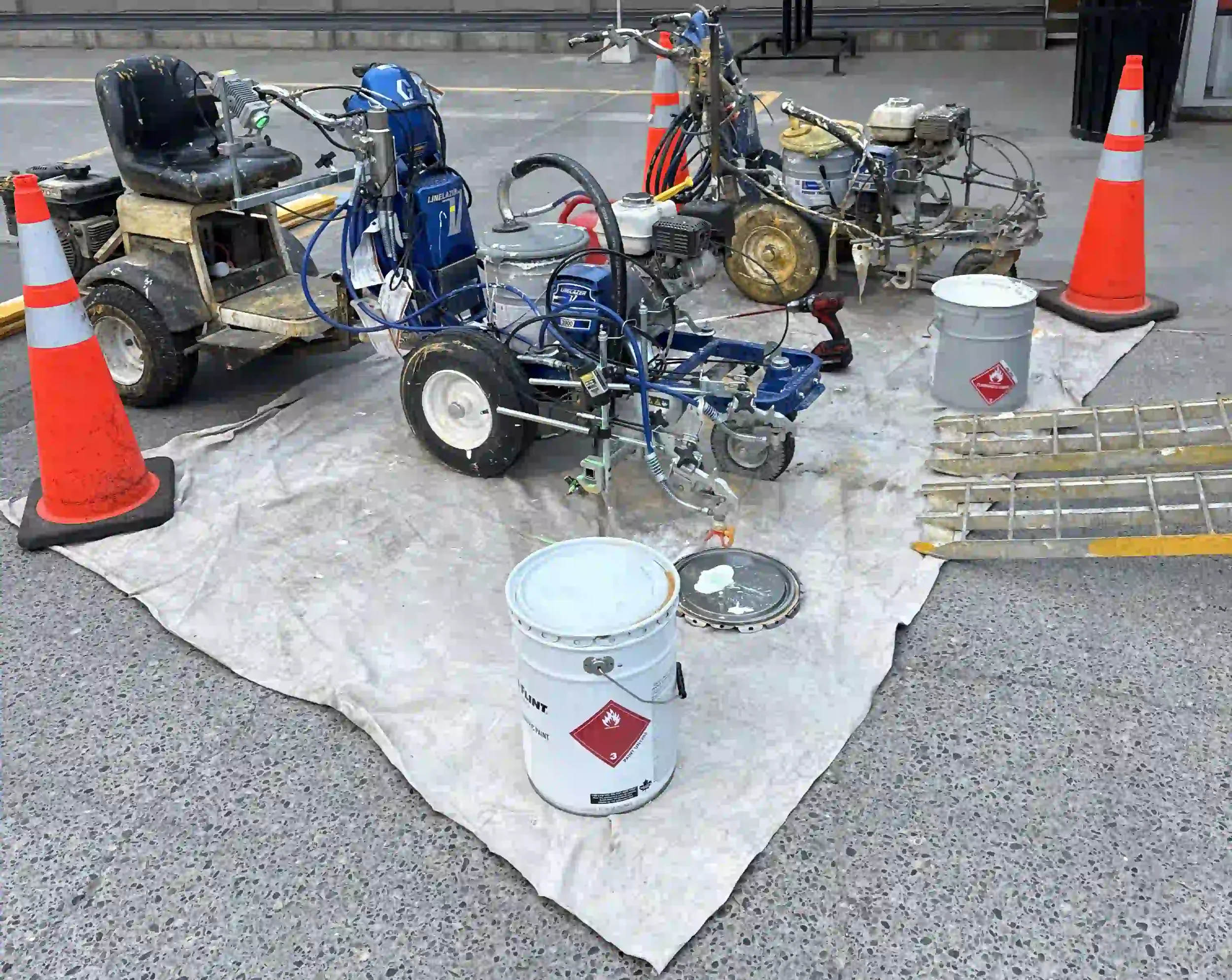
The Paint and Why It Matters
This is where most contractors lose me. They reach for whatever paint is on the truck and call it good. I don't. For the McBride Supercharger lot, we used MPI-spec waterborne acrylic traffic paint in three colours: Yellow for the access aisle hatching and the accessible parking symbol (BC convention often uses yellow for these markings, distinct from the blue ISA you see in some U.S. jurisdictions). White for standard stall lines and any directional markings. A traffic-grade reflective glass bead dropped into the wet paint for night visibility. A few things about paint on a charging station lot specifically: Waterborne acrylic is the right call for new asphalt. Solvent-based paints can react with the oils in fresh asphalt and never cure properly. Waterborne acrylic — the same family of paint specified for most BC municipal road work — adheres cleanly, dries fast (often within 15–30 minutes to touch under good conditions), and stands up to UV, freeze-thaw cycles, and the chemical exposure from fluids that get tracked into a charging lot. Glass beads are not optional. The beads are the difference between a line you can see at night and a line that disappears the moment your headlights are at the wrong angle. We drop beads into every line on a commercial job. At a 24/7 charging station, that's even more important — drivers are pulling in at 2 a.m. in the rain and they need to see the stall edges clearly. Line widths matter. Standard parking stalls in BC are typically a 4" line. Crosswalks and high-visibility markings get 6" or wider. For accessibility access aisles, we run a wider hatched stripe at consistent 45° angles, spaced for visibility. Application thickness affects longevity. A thin coat looks fine for a month and then disappears. A properly applied line — the right wet film thickness, applied at the right tip pressure, with beads embedded while the paint is still wet — should hold its appearance for 18 to 36 months on a commercial lot, depending on traffic and snow plow exposure.
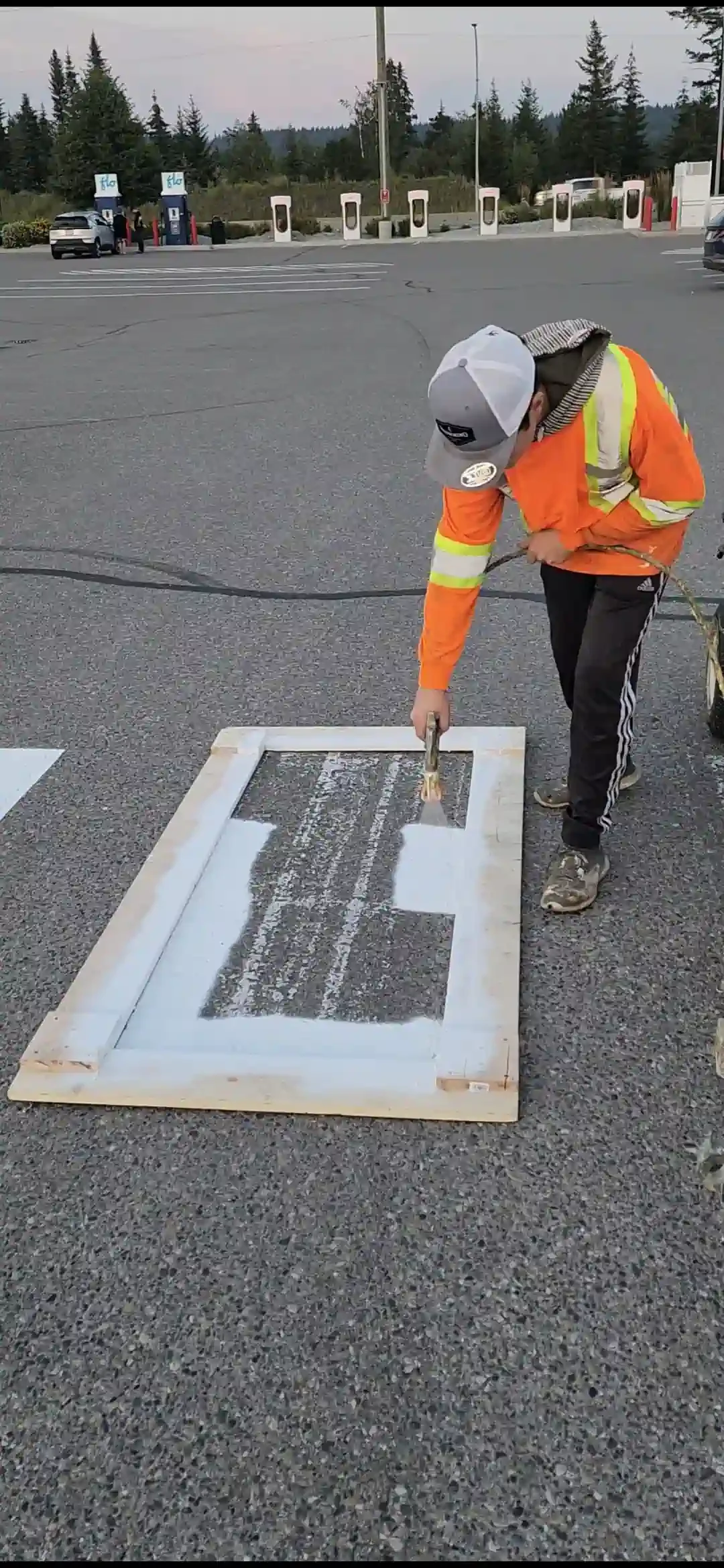
The Hatched Access Aisle and the ISA Symbol
The part of the McBride lot I'm probably most particular about is the accessible parking. If you've seen the photos — bright yellow diagonal hatching beside a wheelchair symbol on fresh, jet-black asphalt — that section took the longest, by design. Here's what goes into it: The access aisle. This is the marked area beside an accessible parking stall where someone can deploy a ramp, transfer from a wheelchair, or load mobility equipment. It has to be wide enough (typically 1.5 m / 5' minimum, often wider for van-accessible spaces), the diagonal stripes have to be evenly spaced and angled at roughly 45°, and it has to be clearly distinct from the driving lane. We pre-mark every diagonal with chalk before any paint hits the surface. Each stripe gets the same width and the same spacing — typically 1 metre on centre. The eye is very forgiving of a perfectly geometric pattern and very unforgiving of one that drifts. If two stripes are off by a couple of inches, your brain picks it up immediately even if you can't say why. The ISA symbol. The International Symbol of Access — the wheelchair pictogram — is a regulated graphic. The proportions, orientation (always facing right unless mirrored for wall mounting), and clear space around it are spelled out in standards. We use a precision-cut industrial stencil so the symbol comes out the same every time, then mask carefully to avoid overspray. Reflectivity at the symbol. Beads go into the symbol the same way they go into the lines. At night, in a snowstorm, when a Tesla driver pulls in to charge — that symbol still needs to read clearly. Path of travel from stall to charger. This is the part most contractors miss. The accessible stall and access aisle are useless if there's a curb or obstacle between the stall and the Supercharger pedestal. On the McBride layout, we positioned the accessible parking so the path of travel was flat, direct, and didn't cross the heaviest traffic flow. This is also where my background as a certified mechanic shows up in a way you might not expect. When you've spent years working on vehicles and equipment, you develop a feel for how machines and humans interact in a tight space. You know how a door swings open. You know how somebody loads a wheelchair from a van side door versus a back hatch. That mental model carries straight into how I lay out a parking space.
What the Finished Lot Looks Like
When we finished and pulled off the site, the lot had: A row of clearly marked Tesla Supercharger stalls aligned to each pedestal. Crisp, beaded white stall lines with consistent spacing. A fully hatched yellow access aisle next to the accessible stall. A bright yellow ISA symbol painted to standard proportions. Clean directional flow so drivers entering from the gas station could pull through to a charger and back into a stall without a guessing game. The Tesla Supercharger station officially turned on a few days later, in early June 2024, becoming the first and only fast-charging station in McBride and filling a critical gap on Highway 16 between the Prince George Supercharger and Jasper. For drivers coming down out of the Rockies, it changed what was possible on that route. When I drive past it now on the way to other jobs further east, the lines still look sharp. That's the goal. A line painting job that holds up isn't a marketing stat — it's whether the work is still doing its job two summers later.
Why We Take These Jobs Personally
Epic Pavement is a small operation. I founded the company in Prince George in 2023 with the goal of doing solid work, treating customers well, and building something my family could be proud of. Just careful work. A project like the McBride Supercharger station mattered to me for a few reasons: It's the kind of infrastructure that opens up the country. EV drivers couldn't reliably make this stretch of highway before that station existed. Now they can. It's in a small town. McBride has a population of around 600. A clean, professional lot at the busiest stop in town signals something. Small towns deserve the same quality of work as Vancouver or Kelowna, and that's how I approach every job in Vanderhoof, Quesnel, Williams Lake, Dawson Creek, and every other community we serve across Central and Northern BC. It's a job that gets used by everyone. Tesla drivers. Disabled drivers. Locals fueling up at the Petro-Canada. Truckers passing through. A well-laid-out, well-marked parking lot quietly does its job for thousands of people who'll never know who painted it. That's a kind of work I like doing.
Need Line Painting for an EV Charging Station, Parking Lot, or Commercial Property?
Get a free quote:
📞 Call us direct: (250) 617-8289 ✉️ Email Dennis: info@epicpavement.ca 🌐 Request a quote online
FAQs
-
A new layout the size of an 8-stall charging station lot typically takes a single working day for the painting itself, plus a half-day for layout and pre-marking. Larger lots scale from there. Drying time on waterborne acrylic is short — typically 15–30 minutes to touch and a couple of hours before driving on the lines.
-
Yes, with the right paint. We use MPI-spec waterborne acrylic traffic paint, which is formulated to bond properly to fresh asphalt without the curing issues you can get with solvent-based products. We always confirm the surface is fully dry and free of any release agents before applying.
-
On a properly executed commercial job with quality paint, glass beads, and the right film thickness, you should expect 18–36 months of clear visibility before a refresh — depending on traffic volume, snow plow activity, and UV exposure. EV charging lots tend to fall on the higher end of that range because traffic is steady but slow.
-
Yes. Epic Pavement provides parking lot line painting and pavement marking for EV charging stations, gas stations, retail lots, apartment complexes, airports, and commercial properties throughout Central and Northern BC, including Prince George, Vanderhoof, Quesnel, Williams Lake, Mackenzie, Valemount, Fort St. John, Dawson Creek, and surrounding communities.
-
Yes. Accessible parking layouts, ISA symbols, hatched access aisles, and path-of-travel markings are part of our standard line painting service and are laid out in line with CSA B651 and applicable BC accessibility guidance.
-
Epic Pavement is fully insured and WSBC-compliant, and we stand behind every job. If something doesn't look right, we want to hear about it and make it right.