Project Highlight: Asphalt Repair and Catch Basin Restoration at Kandola Plaza, Prince George, BC
By Dennis Kuebler, Founder & Owner, Epic Pavement

Project Snapshot
Project: Catch basin clean-out, saw-cut removal of failed asphalt, full-depth asphalt patch installation
Location: Kandola Plaza, 10th Avenue, Prince George, BC
Completed: May 2026
Scope: Failed pavement around a catch basin in a high-traffic commercial parking lot; full-depth removal and replacement of approximately a 1.5 m × 1.5 m section, tied cleanly into the surrounding asphalt
Conditions: Busy active parking lot with steady vehicle and pedestrian traffic throughout the work
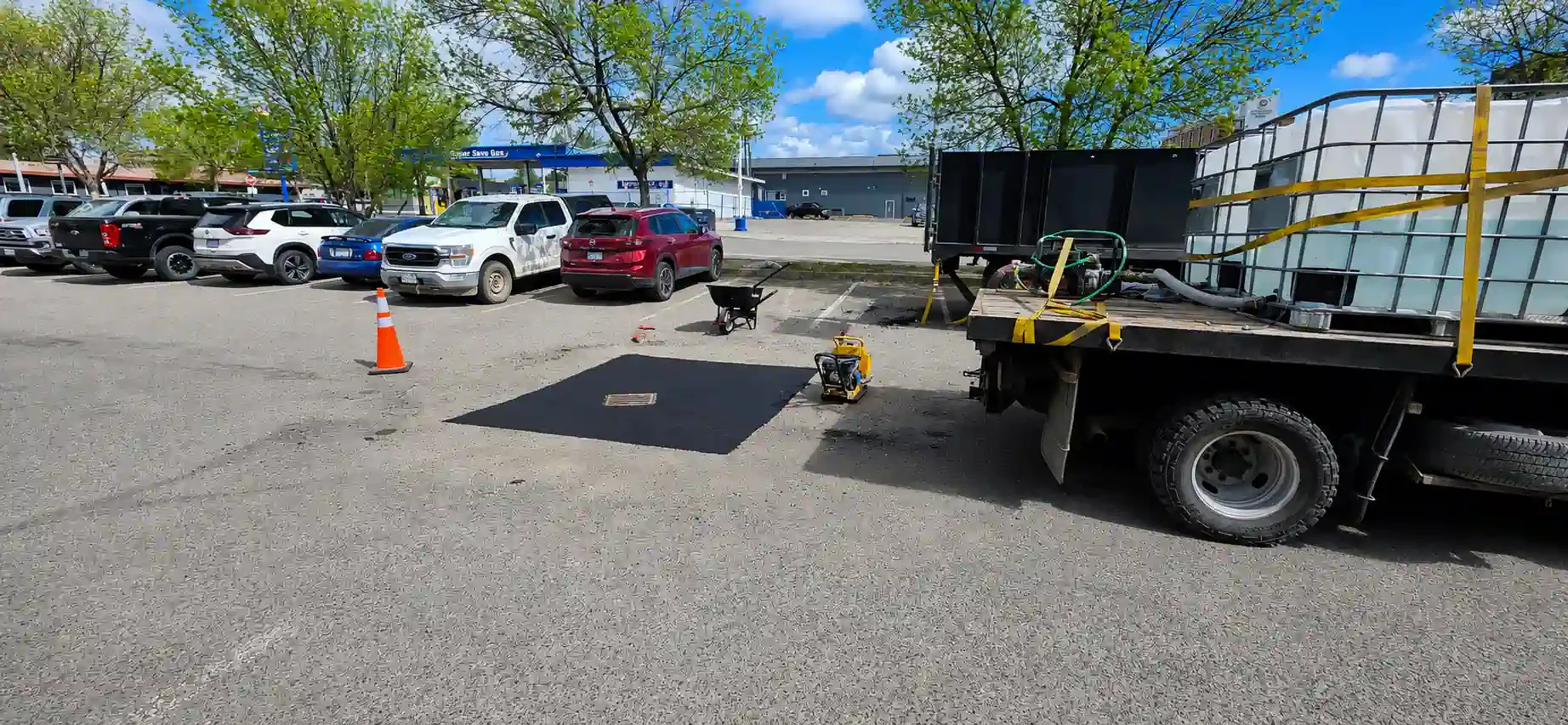
Equipment: Walk-behind asphalt saw, jackhammer and air tools, plate compactor, compact wheel loader for material handling, hot mix asphalt sourced from a Prince George supplier
Epic Pavement is a Prince George, BC-based pavement marking and asphalt maintenance company serving Central and Northern British Columbia. Founded by Dennis Kuebler in 2023, we focus on parking lot line painting, line striping, accessibility markings, asphalt repair, crack filling, parking lot sweeping, and snow removal for commercial, industrial, and residential properties.
Kandola Plaza sits right in the middle of one of the busier commercial strips in Prince George(yeah, you guessed it right, that’s where the Wall Of Fame is). Cars come and go all day. Tenants and customers are walking the lot constantly. It's the kind of property where you can't just close off a section and take three days to do the job — the lot has to keep working while you work.
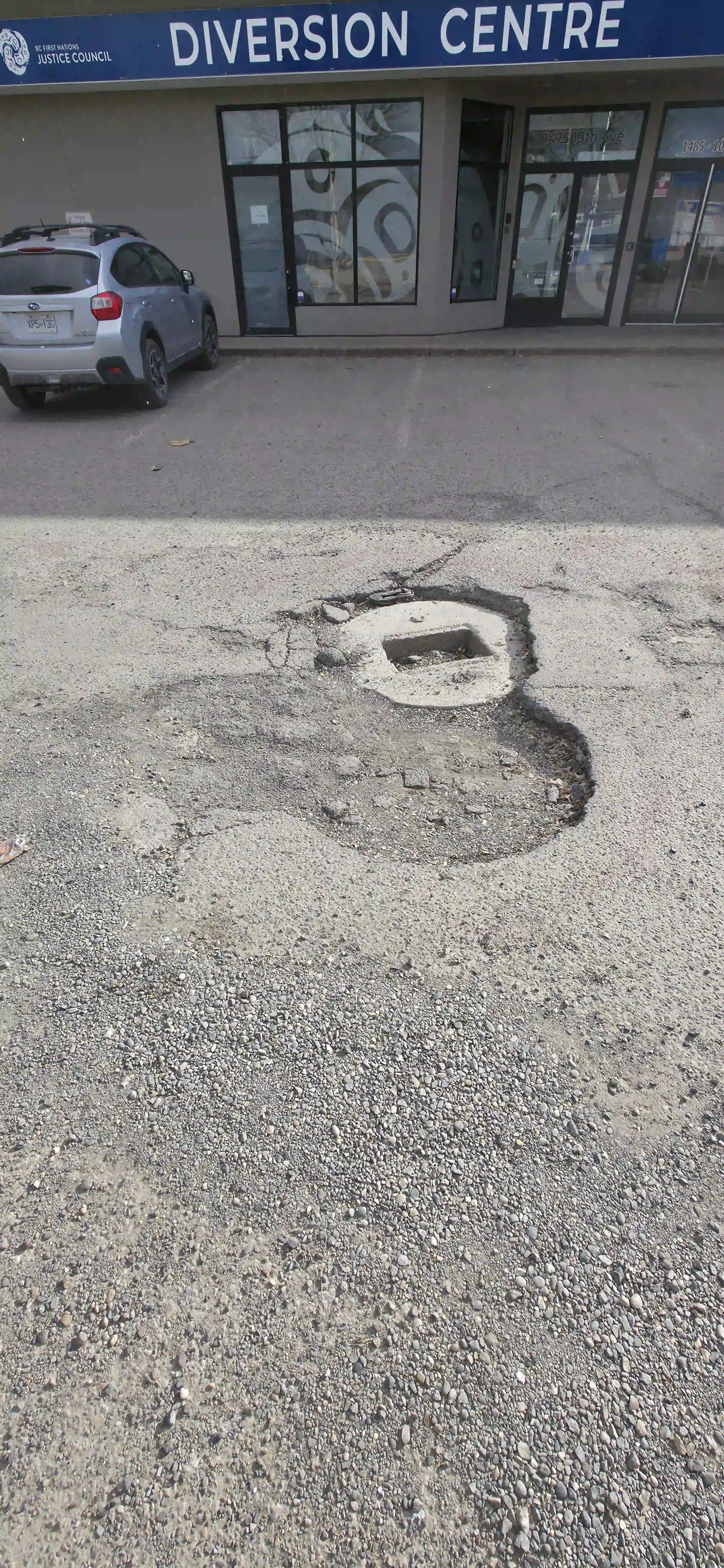
That was the situation we walked into for this one. A catch basin in the parking lot had failed: the asphalt around the grate had broken up over years of freeze-thaw and traffic load, water was pooling around the drain instead of going down it, and the broken pavement had spread outward in a rough circle of cracks, loose chunks, and a dished-out low spot that was only going to get worse with the next winter.
This is the story of how we cleaned out that catch basin, cut out the failed asphalt around it, installed a new full-depth patch, and got the lot back open to traffic — all without shutting the property down.
Why Asphalt Repair Around a Catch Basin Is a Different Kind of Job
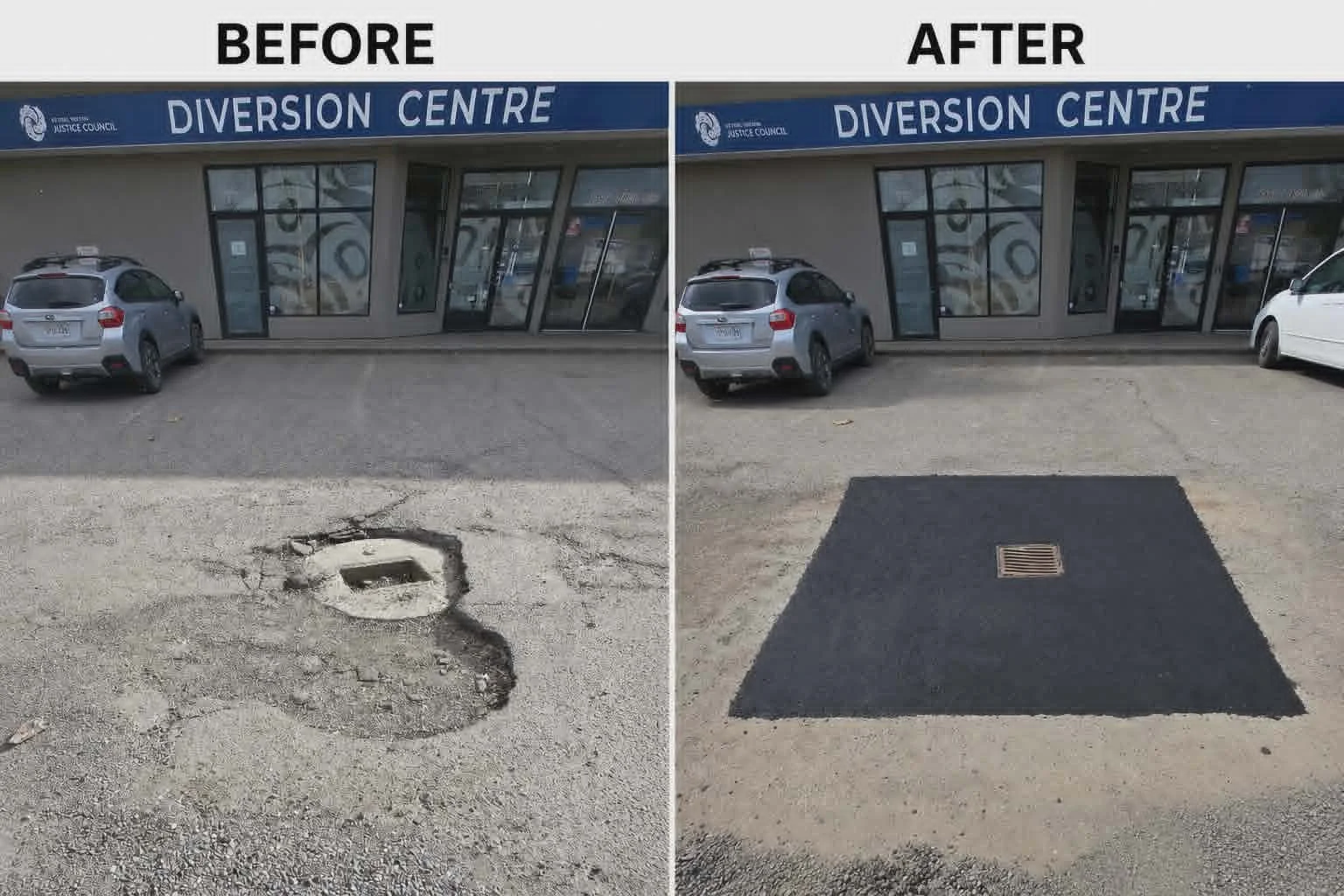
Most people see a pothole and think "fill it." If only it were that simple. A catch basin repair is one of the trickiest small-scale asphalt repairs in the business, and the reason is in the picture itself: the failure isn't really about the asphalt — it's about water.
A few things make a catch basin patch different from a standard pothole repair:
The catch basin is the lowest point. All the surface water in that section of lot is flowing toward the drain. That means any weakness in the asphalt around the grate is being attacked by water constantly — every rainfall, every melting snowpile, every truck wash that drips fluid down to the basin.
Freeze-thaw is brutal at the basin. Water gets into the smallest crack between the asphalt and the cast-iron frame, freezes, expands, breaks the bond, and the next thaw drops more water in. Multiply that by a Prince George winter and you get exactly what we saw on the before photo: the pavement around the grate cracked into a halo of broken chunks.
The drain itself often needs work before the asphalt does. If the catch basin is partially blocked, or the frame has shifted, or the structure underneath has settled — patching new asphalt on top is throwing good money after bad. You'll be back in two years.
The patch has to tie into the existing grade. Water has to keep flowing into the basin, not pond around the patch. That means the new asphalt has to feather correctly into the surrounding pavement so the slope still drains. Get it wrong and you've created a new low spot somewhere else.
When a property manager calls me about a "pothole by the drain," I usually slow the conversation down and walk through these details. It's not the same as patching a hole in the middle of the lot. If we're going to be there, we're going to do it properly so it doesn't come back.
Reading the Site Before Any Saw Blade Hits the Asphalt
Before we cut anything, I walk the failure. Here's what I'm checking on a catch basin repair like this one:
The catch basin itself. I lift the grate and look down. Is the frame solid, or has it shifted? Is the basin clear or is it full of sediment, leaves, and asphalt debris? In this case, the drain needed to be cleaned out before we did anything else — sediment had built up enough that water wasn't moving through it the way it should. That gets dealt with first.
The extent of the failure. The visible broken asphalt is usually only part of the problem. I press around the edges with a probe or a heel. Anywhere the pavement flexes or sounds hollow, the failure goes further than the eye sees. I mark the actual cut line a generous margin outside the visible damage so we cut into pavement that's still sound. There's no point patching to broken edges — they'll fail again.
The base condition underneath. Once the failed asphalt is out, we'll see what's under it. If the gravel base has been undermined by water tracking from the catch basin, that base needs to be rebuilt before any new asphalt goes back. You don't patch over a soft base.
The grade around the basin. I look at how water is supposed to flow toward the grate from every direction. The new patch has to preserve that drainage pattern. If we make the patch even slightly proud of the surrounding asphalt, water will hit it and route around instead of into the basin.
Traffic flow. Kandola Plaza is busy. I plan out exactly where my truck and skid steer will sit, where the cones go, where pedestrians can still safely pass, and which direction vehicles can route around the work. The goal is to take up the smallest footprint possible for the shortest time possible.
That site read takes time, and it's the part most people don't see. But it's the part that decides whether the patch is still doing its job in five years or breaking apart by next spring.
The Equipment We Run
For asphalt repair work like the Kandola Plaza job, Epic Pavement runs the same class of equipment we'd bring to a much larger asphalt repair contract — saw-cut, hand-prep, machine-place, and compact. Specifically:
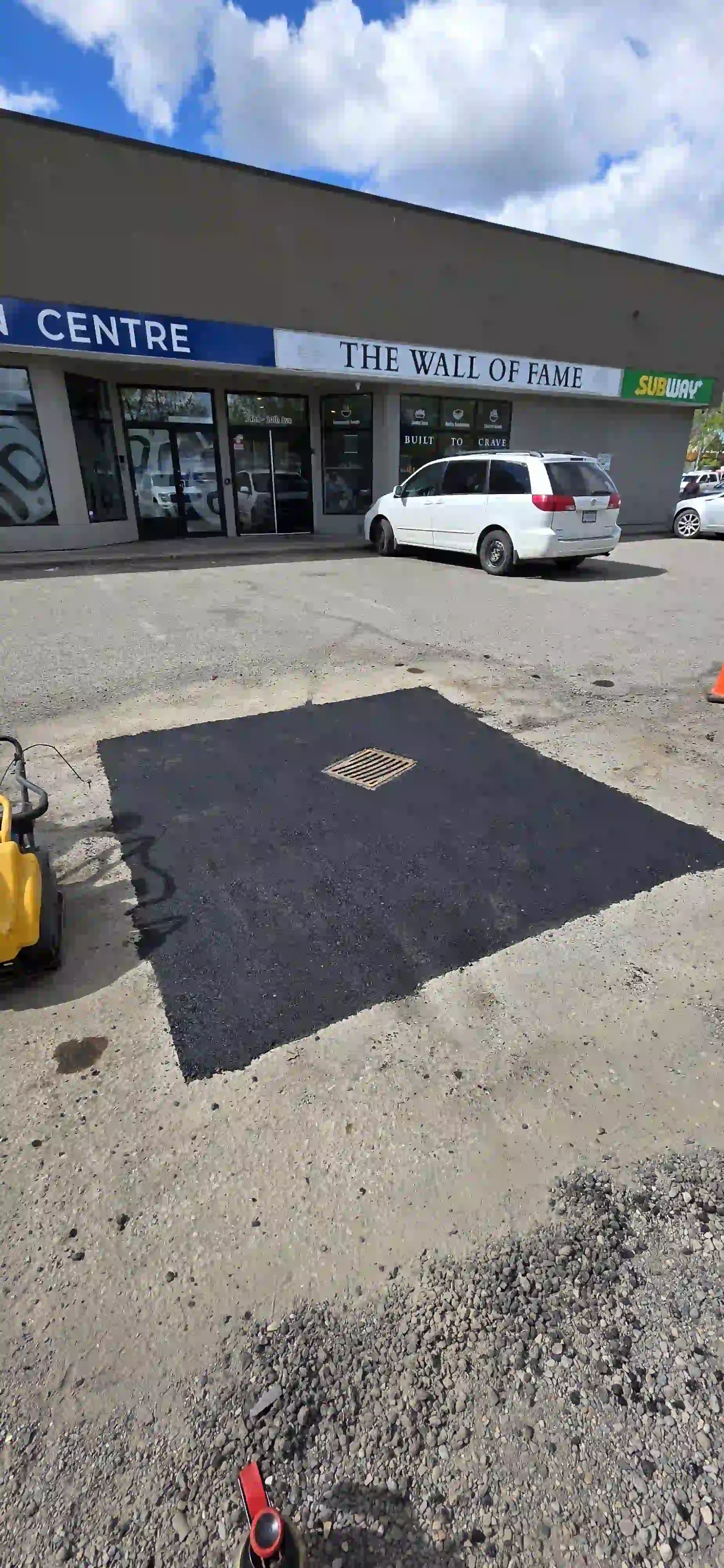
A walk-behind asphalt saw with a diamond blade. This is what gives us the clean rectangular cut you see in the finished photo. Saw-cutting is non-negotiable on a quality patch. The alternative is breaking the pavement back with a jackhammer to a ragged edge, and ragged edges fail. A clean vertical saw-cut gives the new hot mix a flat face to bond against.
Jackhammer and air tools for breaking out the failed asphalt inside the saw-cut perimeter, and for trimming the cast-iron catch basin frame area where the saw can't reach.
Hand tools for prep — shovels, rakes, brooms, and a backpack blower to clean the cut area to bare base before tack coat goes on.
A plate compactor for compacting the gravel base if it needs rebuilding, and for compacting the new hot mix asphalt in lifts.
A compact wheel loader for hauling broken asphalt out and bringing new hot mix in. Anyone who's seen our gear knows about workhorse of our small-equipment fleet.
A trailer-load of hot mix asphalt sourced fresh from a local Prince George supplier on the morning of the job. Hot mix has to be placed and compacted while it's still hot — typically above 120°C — so logistics matter. We coordinate the pickup so the asphalt arrives on site when we're ready to lay it, not before.
The Materials and Method
The actual sequence on a catch basin patch like this one runs roughly like this:
1. Clean the catch basin. Before any asphalt comes out, the basin gets cleaned. Sediment, debris, and any old asphalt fragments come out. We confirm the drain is moving water properly. If the frame has shifted, that's adjusted now. If the structure underneath needs attention, we deal with it before we ever pour asphalt above it.
2. Saw-cut the perimeter. A clean rectangular cut a generous margin outside the visible damage. Vertical, full-depth through the existing asphalt. The shape matters — squares and rectangles patch better than circles or irregular outlines because they give you straight bonded edges on all four sides.
3. Remove the failed asphalt. Inside the saw-cut, the broken pavement comes out with the jackhammer and shovels. We're aiming to get down to a clean, sound base.
4. Prep the base. The exposed base gets cleaned of loose material, inspected, and re-compacted with the plate compactor. If the base has been washed out or undermined, this is when we bring in fresh granular and rebuild it to the right elevation. The base has to be solid, flat, and at the right depth before any asphalt goes back in.
5. Tack coat the vertical edges. A thin coat of emulsified asphalt goes on the vertical saw-cut faces and around the catch basin frame. This is the glue that bonds the new hot mix to the existing pavement. Skip this step and your patch will separate from the surrounding asphalt within a couple of seasons — you'll see the seam open up as a crack and water will get back in.
6. Place and compact the hot mix. Fresh hot mix asphalt goes into the cut in lifts — typically two passes if the patch is deep — with the plate compactor between each lift. The final lift is placed slightly proud of the surrounding pavement so it compacts down flush. We feather and roll the edges into the existing asphalt so the transition is smooth and water can still flow naturally toward the drain.
7. Final grade check. Before we leave, I walk the patch with a straight edge and a level. Water should still flow off the surrounding lot into the catch basin without ponding on or beside the patch. If anything doesn't read right, it gets fixed before the asphalt cools.
A few notes on why we do it this way:
Hot mix versus cold patch. For a permanent commercial repair, hot mix is the right call. Cold patch is a temporary solution — it has its place for emergency repairs in the middle of winter when no hot plant is running, but it won't hold the way a properly placed hot mix patch will. On a busy commercial lot, we use hot mix.
Full depth versus surface patch. When the failure is around a catch basin, we cut and replace the full depth of the asphalt — not just a skim coat. The failure isn't only on the surface; the bond between the asphalt and the basin frame is broken, and a surface-only patch doesn't address that. Full-depth costs more on day one and saves money on day three hundred.
Compaction is everything. A poorly compacted patch will rut, ravel, and fail. We compact in lifts, we check density, and we don't rush the rolling. The difference between a patch that lasts three years and one that lasts ten is mostly in the compaction.
Working in a Busy Parking Lot Without Shutting It Down
This is the part of the Kandola Plaza job that took some planning. The lot couldn't be closed. Tenants were open for business, customers were coming and going, and pedestrians were crossing the lot all day. Here's how we handled it:
Tight footprint. Our work zone was no bigger than it needed to be — the patch area plus enough room for the skid steer to swing and the saw to operate, all coned off so vehicles and pedestrians could see exactly where not to step.
Phased traffic flow. We worked one half of the access flow at a time where we could. Drivers entering the lot were routed around the work zone without having to back up or guess. A flagging approach when it was needed.
Quick turnaround. Catch basin patches in the middle of a working lot are jobs where every hour the area is closed off costs the tenants and the property. We came prepared so the saw-cut, removal, base prep, placement, and compaction could all happen in a single visit. By the time the hot mix had cooled enough to drive on (typically a few hours after compaction in good weather), the lot was fully open again.
Clean exit. Sweep up. Pick up cones. Confirm with the property contact that the work zone is clear and the patch is ready for traffic. We don't leave loose gravel, paint marks, or debris on a commercial lot.
The point of all of this is that good asphalt repair on an active commercial property is as much about logistics and communication as it is about hot mix and compaction. Property managers don't want a repair contractor who treats their lot like a construction site for a week. They want someone who shows up, does it right, and gets out of the way.
What the Finished Lot Looks Like
When we pulled off the site, the lot had:
A clean, rectangular hot mix patch around the catch basin, flush with the surrounding pavement. A drain that was clear, properly seated, and actively pulling water off the lot during the next rain. Smooth transitions on all four edges so vehicles rolling over the patch don't feel a bump. No loose material, no rough edges, and no ponding water. Drainage routing exactly the way it was supposed to — into the basin, not around it.
The before-and-after photos tell the story better than I can. Before: a halo of broken asphalt and chunks of failed pavement around a drain that wasn't doing its job. After: a clean, professional patch that looks like part of the original lot.
That's the goal on a patch like this. A good asphalt repair isn't about making the patch look pretty for a week — it's about whether the repair is still tight and still draining in three winters' time. That's how we judge our work.
Why We Take These Jobs Personally
Epic Pavement is a small operation. I founded the company in Prince George in 2023 with the goal of doing solid work, treating customers well, and building something my family could be proud of.
A job like the Kandola Plaza patch mattered to me for a few reasons:
It's the kind of repair that gets ignored until it's a big problem. A cracked patch of asphalt around a drain is exactly the kind of thing property managers walk past for two years because it's "not urgent." Then one winter the failure spreads, the base washes out, and what could have been a one-day patch becomes a much bigger repair. Catching it when we did saved the property real money.
It's a busy property in our own city. Prince George is home. Kandola Plaza is somewhere people in this city go every week. Doing clean work on a property that local people use matters.
It's the kind of work that quietly does its job. Most of the people parking at Kandola Plaza will never notice that patch. They won't notice the drain works. They won't notice the lot doesn't have a low spot anymore. That's exactly the point. A well-done asphalt repair is invisible — which is harder than it sounds.
Need Asphalt Repair, Pothole Patching, or Catch Basin Work for Your Property?
Get a free quote:
📞 Call us direct: (250) 617-8289
✉️ Email Dennis: info@epicpavement.ca
FAQs
-
A single-basin repair of this size — roughly a 1.5 m × 1.5 m patch — typically takes a single working day from saw-cut to compacted patch. The hot mix needs a few hours to cool enough to drive on, but by the end of the day the lot is fully open. Larger or more complex repairs scale from there.
-
In most cases, yes. We work in a tight footprint, cone off only the active work zone, and route vehicles and pedestrians around the area. For a single-patch repair like Kandola Plaza, the surrounding lot stays open the entire time we're on site.
-
Most asphalt failures around catch basins start with the drain — either the basin is partially blocked, the frame has shifted, or the structure underneath has settled. Patching the asphalt without dealing with the drain is a short-term fix. We clean and inspect the basin first, then deal with the pavement.
-
For a permanent commercial repair, yes. Hot mix bonds properly to the surrounding pavement, compacts to full density, and lasts. Cold patch has its place for emergency winter repairs when no hot plant is running, but it's a temporary solution. On a commercial lot, we use hot mix.
-
A full-depth hot mix patch on a properly prepared base, with the surrounding drainage working correctly, should last as long as the rest of the lot — often a decade or more before the seam shows wear. The seam is usually the first thing to start cracking, and that's where periodic crack sealing comes in to extend the patch life further.
-
Yes. Epic Pavement provides asphalt repair, pothole patching, catch basin repairs, and crack filling for commercial and residential properties throughout Central and Northern BC, including Prince George, Vanderhoof, Quesnel, Williams Lake, Mackenzie, Valemount, Fort St. John, Dawson Creek, and surrounding communities.
-
Epic Pavement is fully insured and WSBC-compliant, and we stand behind every job. If something doesn't look right, we want to hear about it and make it right.