A practical reference from the team at Epic Pavement, a Prince George–based pavement maintenance contractor serving Central and Northern British Columbia.
Asphalt maintenance work in Central & Northern BC — Epic PavementTable of Contents
Introduction
Why This Guide Exists
Part 1 — Why Your Asphalt Is Deteriorating Right Now
The chart that explains every decision you'll make about your asphalt
Why Central and Northern BC is harder on pavement than the rest of the province
Part 2 — How to Read Your Pavement: A Field Diagnosis Guide
Distress 1: Hairline & transverse cracks
Distress 2: Longitudinal cracks
Distress 3: Alligator (fatigue) cracking
Distress 4: Raveling
Distress 5: Rutting and depressions
Distress 6: Potholes
A 20-minute pavement triage you can do yourself
Part 3 — The Four Maintenance Services
Service 1 — Crack Sealing
Service 2 — Asphalt Repair
Cold patch
Hot mix asphalt
Infrared repair
Asphalt overlay
Service 3 — Parking Lot Sweeping
Service 4 — Parking Lot Line Painting
Part 4 — An Honest Look at Sealcoating
The case for sealcoating
The case against in our climate
Part 5 — Building an Annual Maintenance Program
The year-round sequence
What this looks like as a budget
Part 6 — How to Vet a Pavement Maintenance Contractor
Three diagnostic questions
Walk me through the maintenance sequence and why
What's your crack sealing scope and timing?
How are you handling accessible stalls under local bylaw?
What to look for in a quote
Things that should make you cautious
Things that should give you confidence
A Note for Residential Property Owners
Scaled-down advice — same priorities (crack sealing > repairs > sweeping), sealcoating closer call for residential, cold patch + annual walk + September sealing = maintenance
How Epic Pavement Works
Company approach — documented site assessment + multi-year plan, climate-sequenced work, honest about trade-offs, bylaw compliance, proactive repair
Frequently Asked Questions
Q&As:
How often should a commercial lot be maintained?
What's the cheapest task that matters? (crack sealing)
Do I need to sealcoat?
Cold patch vs. hot mix difference?
What is infrared asphalt repair?
What is asphalt overlay?
Are accessible parking stalls regulated in BC?
How do I know if issues are surface-level or structural?
How long should a properly maintained lot last?
Sources & Further Reading
Pavement engineering and economics — Pavement Interactive, FHWA, BC MoT Pavement Structure Design Guidelines, BC Standard Specs
Provincial and local regulations — BC Building Codes, PG Zoning Bylaw 7850, local bylaw enforcement
Air quality and regional environmental context — PGAIR, BC Air Quality Warnings, Environment Canada AQHI
Workplace safety and liability — WorkSafeBC slip-and-fall data
Industry standards bodies — TAC (Transportation Association of Canada), Asphalt Institute
Why This Guide Exists
Most asphalt content online is written for southern climates and big-city property managers. It gets the basics right and the specifics wrong. The freeze-thaw realities of Central and Northern British Columbia — the long winters, the deep frost penetration, the volume of winter sand we put down between October and April, the accelerated aging that comes from all of it — are not the realities a contractor in Vancouver, Calgary, or Seattle is dealing with.
This guide is for the people who actually deal with those realities: property owners, facility managers, strata councils, business operators, and homeowners across Central and Northern BC, from Williams Lake up through Prince George, Vanderhoof, Quesnel, Mackenzie, Smithers, Terrace, and into the Peace. We've structured it as a true field guide — something you can read end-to-end, or skip into a specific section when you need to diagnose a specific problem on your property.
If you've ever stood in front of a deteriorating parking lot in May, looking at a quote from a contractor that's three times what you budgeted, and wondered how it got that bad — this is for you. The answer is usually that the cheapest version of the work could have happened three years earlier and didn't. This guide explains why, and how to keep it from happening again.
We're Epic Pavement, a locally-owned pavement maintenance contractor based in Prince George. We provide asphalt repair, parking lot sweeping, and parking lot line painting for commercial and residential clients across the region, along with snow removal through the winter. What follows is the same conversation we have with clients on a pre-season site walk, written down.
Part 1 — Why Your Asphalt Is Deteriorating Right Now
The chart that explains every decision you'll make about your asphaltThere's a chart that everyone in this industry knows. It comes from a 1985 study published by the U.S. Federal Highway Administration (Stevens, Road Surface Management for Local Governments, FHWA Publication DOT-I-85-37) and it has been re-confirmed by every major DOT and pavement research consortium since, including the Pavement Tools Consortium — a partnership between U.S. state DOTs, the FHWA, and the University of Washington that maintains the industry's authoritative reference resources.
The chart shows pavement condition over time. And what it shows is not a straight line down. It's a curve.
Here's the killer number: for the first 75% of a pavement's life, condition drops by about 40%. That sounds bad until you see what comes next: the next 40% drop happens in just 17% of the remaining life. The deterioration accelerates. Cracks that were tight last fall are wide open by next spring. Potholes that were hairline depressions become structural problems. The asphalt that was "fine" five years ago is structurally compromised in two more.
And here's the cost number — also from the same FHWA source, also widely cited across the industry: restoring pavement to a reasonable condition costs four to five times more if you let it deteriorate for even two to three years past the optimum maintenance point. Not 20% more. Not double. Four to five times more.
This is the math behind every asphalt maintenance decision you'll ever make. The pavement is going to deteriorate. The only question is whether you intervene in the first 75% of its life — when small fixes are cheap and effective — or whether you wait until you're in the accelerated-failure zone, where small fixes don't work anymore and you're paying for full reconstruction.
The Pavement Tools Consortium summarizes the principle in one line: "once a pavement needs treatment, the sooner a maintenance or rehabilitation activity is undertaken, the more cost-effective it will be."
Most commercial property owners we meet are in the late-50% to mid-70% range of pavement life and don't know it. The lot looks fine. The deterioration is invisible until it isn't. And the contractor who shows up the year after that — usually with a repaving quote — is selling them the four-to-five-times-more-expensive version of the work that should've happened three years earlier.
Why Central and Northern BC is harder on pavement than the rest of the province
The 75%/17% curve is universal — it applies whether you're in Tampa or Tumbler Ridge. But the rate a specific property travels along that curve is climate-dependent, and our region is on the harsh end of the BC spectrum.
Three things are working against your asphalt up here, and they compound:
Freeze-thaw is the dominant deterioration mechanism. This is the big one. Water enters cracks. Water freezes. Frozen water expands roughly 9% in volume. The crack widens. The thawed water — now in a wider crack — re-freezes the next night. The crack widens further. Repeat for five to six months a year, multiple times in a single 24-hour period during shoulder seasons. The phenomenon is well-documented across BC's colder regions; frost heave is identified as a primary structural concern across "Northern BC, the Interior, and the Kootenays" — anywhere "prolonged freezing temperatures and moisture-prone soils combine."
This is why cracks that were 3 mm wide in October are 12 mm wide in April. It is not a maintenance failure. It is physics. The maintenance failure is letting the water enter the crack in the first place.
Climate variation across the region matters. Central and Northern BC is not a single climate zone. Higher-altitude communities like Mackenzie, Tumbler Ridge, or Smithers see longer winters and more freeze-thaw cycles than valley-floor towns. Coastal locations in the northwest — Prince Rupert, Kitimat, Terrace — are warmer and wetter, with less freeze-thaw but more constant moisture exposure. The Interior — Quesnel, Williams Lake, Prince George — is somewhere in between, with significant freeze-thaw plus a long, dry summer that bakes asphalt under UV. Each of these microclimates ages asphalt slightly differently, but all of them age it faster than a Vancouver or Victoria climate would.
Winter sand is part of the system. Across most of the region, municipalities and private property operators spread coarse winter traction material on roads and lots all winter — the BC Ministry of Transportation StandardSpecifications for Highway Construction covers the provincial side, while local jurisdictions handle municipal roads. That sand has to go somewhere when the snow melts. Left on the asphalt surface into spring, it creates an abrasive layer that grinds against the pavement under every vehicle that drives over it. It's also an air quality issue — particularly in mill towns with valley topography (Prince George, Quesnel, Williams Lake) where wintertime thermal inversions trap pollutants near the surface. The Prince George Air Improvement Roundtable is the most established example, but the pattern repeats in similar communities across the region.
Petroleum and oil drips. Asphalt is a petroleum product. Oil drips from vehicles dissolve the asphalt binder over time, creating soft spots and accelerating raveling (the loss of surface aggregate). High-traffic commercial lots — particularly drive-thru queues, loading bays, and where vehicles idle — show this damage first.
The combined effect: a parking lot in our region that would last 25 years in a temperate climate might be in serious condition at 15 years if it's never been maintained. The same parking lot, with consistent crack sealing and surface care, can comfortably hit 25 to 30. That gap is what a real maintenance program is buying.
Part 2 — How to Read Your Pavement: A Field Diagnosis Guide
This is the section that earns the name "field guide." If you can recognize what you're looking at when you walk your property, you can prioritize what to address first and you can talk to a contractor about specifics rather than handing them the whole problem to scope.
There are five distress types every property owner should learn to recognize. They don't all mean the same thing, and they don't all need the same response.
Distress 1: Hairline & transverse cracks
What it looks like: Thin, single cracks running across the pavement, usually perpendicular to the direction of traffic flow. Width starts at about 1-3 mm and widens over time. Often spaced fairly regularly along a parking lot or drive lane.
What's causing it: Most transverse cracks in our climate are thermal cracks — the asphalt contracting in deep cold and pulling itself apart. They start small. The first winter usually opens them to about 3 mm. Each subsequent freeze-thaw season widens them.
What it means: This is the exact moment to intervene. A hairline transverse crack is the cheapest possible repair — crack sealing it for a few dollars per linear metre prevents it from becoming everything else on this list.
What to do: Crack seal them in early fall, while they're at their summer-narrow state. Sealing them in spring catches them at their widest, and the seal will be looser when they contract back in summer.
Distress 2: Longitudinal cracks
What it looks like: Cracks running parallel to the direction of traffic. Most often appear along construction joints (where two paving passes meet), along the centerline of drive lanes, or near the edge of the pavement.
What's causing it: Several possibilities. Construction joint failures are the most common — a longitudinal crack along a paving seam means the joint between two paving passes wasn't compacted to the same density as the surrounding asphalt and the seam has worked loose under traffic. Edge cracks near the perimeter usually mean the base layer is failing under the unsupported edge.
What it means: A longitudinal crack is more serious than a transverse crack because it often indicates an underlying structural issue rather than just thermal stress. But it's still a crack — and a crack is still a water entry point that's accelerating everything underneath.
What to do: Crack seal them on the same fall schedule as transverse cracks, but flag the location for monitoring. If the same longitudinal crack returns within 2-3 years of sealing, the issue is structural and needs a more substantial repair.
Distress 3: Alligator (fatigue) cracking
What it looks like: A network of interconnected cracks forming roughly square or hexagonal pieces — looks like alligator skin, hence the name. Usually concentrated in specific patches rather than spread evenly across the lot. Often appears in heavy-traffic zones — drive lanes, near loading docks, dumpster pads, drive-thru queues.
What's causing it: Structural failure of the pavement system. The asphalt is no longer being properly supported by the base layer underneath. Repeated traffic loading on an unsupported surface fatigues the asphalt to the point where it breaks into the interconnected pattern. By the time you can see alligator cracking, the damage is happening below the surface, not above it.
What it means: This is not a crack-sealing problem. This is a repair problem. The base layer in that area needs to be excavated, repaired, and the asphalt above it replaced.
What to do: Mark the area, photograph it, get a contractor on-site to assess. The repair scope depends on the area — small alligator patches can be cut out and patched with hot mix; large or repeated alligator patches indicate the lot is approaching the structural end of its life and a more comprehensive intervention is needed.
Distress 4: Raveling
What it looks like: The surface looks coarse, gritty, and slightly bumpy. You can see and feel individual stones (aggregate) sitting on the surface or having come loose from it. The colour of the asphalt looks faded — more grey than black.
What's causing it: UV exposure and oxidation. Asphalt binder (the black, sticky stuff that holds the aggregate together) is a petroleum product. Sun exposure breaks it down over years. As the binder oxidizes, it loses its ability to hold the aggregate in place, and the aggregate starts to come loose under traffic and weather.
What it means: Surface-level aging. The structural integrity of the lot is probably still fine — but the surface is no longer waterproof, and the rate of further deterioration is accelerating because water is now entering not just at cracks but across the entire surface.
What to do: Raveling is one of the few legitimate cases for sealcoating in our climate (we'll get to this in Part 4). It can also be addressed with a thin overlay or, for spot raveling, with infrared repair.
Distress 5: Rutting and depressions
What it looks like: Linear depressions in the wheel paths — visible as low spots that hold water after rain or after snow melt. Sometimes barely perceptible visually but obvious as standing water or ice patterns.
What's causing it: Two possibilities. Rutting can be a surface issue — the asphalt mix was too soft for the traffic load and has deformed under repeated wheel loading. Or it can be a base issue — the granular base layer underneath is settling unevenly, and the asphalt is following the base down.
What it means: Rutting is serious because (a) it accelerates water damage by holding water on the pavement instead of letting it drain, and (b) if the cause is the base layer, the problem is structural.
What to do: First, figure out which of the two causes you're looking at. Surface rutting can sometimes be addressed with a thin overlay. Base settlement is a more substantial repair — typically excavating the affected area, rebuilding the base, and re-paving. A contractor walking the site with you should be able to tell the difference based on the pattern and depth of the rutting.
Distress 6: Potholes
What it looks like: You know what a pothole looks like.
What's causing it: Almost always: a crack that wasn't sealed, that let water enter the base layer, that froze and thawed, that eroded the base, that caused a section of asphalt to lose support, that broke off into the void. Potholes are the end-stage of every other distress on this list.
What it means: Immediate liability. Potholes are tripping hazards for pedestrians, vehicle damage hazards for drivers, and in commercial lots, they're often where the first slip-and-fall claim originates. Per WorkSafeBC, slips, trips, and falls are the costliest workplace incidents in BC, costing employers an average of 440,000 lost workdays and more than $148 million in claim costs every year — and parking lot pavement defects are documented contributors.
What to do: Patch them. Cold patch as an immediate temporary fix in any temperature; hot mix as a permanent fix when air temperature is above ~4°C (40°F); infrared if the pothole is shallow and surrounded by otherwise good pavement. We get into the differences in Part 3.
A 20-minute pavement triage you can do yourself
Walk the property with a phone camera, a notebook, and a tape measure. Spend twenty minutes — that's all this takes — and you'll come away with enough information to either confirm everything's fine or have a real conversation with a contractor about priorities.
What to do:
Walk the perimeter first. Edge cracks and base failures show up here first. Note any cracking that's pulled away from concrete curbs or that runs along the outer 30 cm of the asphalt.
Walk the drive lanes. These are where transverse and longitudinal cracks accumulate fastest. Photograph each crack longer than ~30 cm.
Look at high-traffic zones specifically. Drive-thru queues, loading docks, dumpster pads, accessible-stall access aisles. These are where alligator cracking starts. If any of these zones look different from the rest of the lot, mark them.
Look for water patterns. If you can do this walk after rain or melt, you'll see where water is pooling. Standing water = either rutting or a drainage failure, both of which need investigation.
Check the markings. Faded line painting is a curb-appeal issue, but faded accessible-stall symbols are a compliance issue (more on this below).
Photograph everything. A simple phone-photo log with dates is the foundation of any good maintenance program. Annual photos let you actually see whether a crack is getting worse year over year, instead of guessing.
That walk gives you a current snapshot. Combine it with the photos from a year ago — or, if you don't have any, start the log this year and you'll have the comparison next year.
Part 3 — The Four Maintenance Services
Asphalt maintenance is not one service. It's at least four, and they get scheduled at different points in the year for different reasons. Most properties get themselves into trouble by treating it as one annual line item — usually paving — instead of a sequence.
Service 1 — Crack Sealing (the highest-ROI dollar in the program)
Of every dollar you spend on asphalt maintenance, the most leveraged dollar is the one you spend on crack sealing. There is no other intervention with the same cost-to-benefit ratio.
A crack in asphalt is not just a cosmetic issue. It's a water entry point. Once water enters the crack, three things happen:
The water reaches the granular base layer beneath the asphalt and starts eroding it. The base is what gives the pavement its structural support. Erode the base and the asphalt above it loses load-bearing capacity — which is what creates alligator cracking, rutting, and eventually potholes (review Part 2 if you need to).
In freeze-thaw conditions, the water freezes and expands, widening the crack and creating a faster water entry point next time.
Dirt, debris, and seeds get into the crack, holding it open even when dry, and (for the seeds) literally growing roots that pry the pavement apart.
Crack sealing stops all three. The technique uses a hot-applied rubberized polymer-modified sealant — not the same as the cold-pour crack filler you can buy at a hardware store. Hot-applied rubber sealant is heated to roughly 180-200°C (350-390°F), pressure-applied into the crack from a melter unit, and squeegeed flush with the surface. When it cools, it forms a flexible, waterproof seal that moves with the pavement as it expands and contracts seasonally. Properly applied, a crack seal will last five to seven years.
Three things to know about crack sealing in our region:
Timing matters. The best window is late summer to early fall, when cracks are at their summer-narrow state and the surface is dry and warm enough for the sealant to bond properly. Sealing cracks in cold weather is a partial fix at best. Sealing in spring catches cracks at their winter-wide state, which means you're sealing more material into a crack that will narrow back down — also not ideal.
Not every crack is sealable. Hairline cracks (under about 3 mm) are often too narrow for sealant to penetrate effectively. Wider cracks (over about 25 mm) are usually beyond crack sealing and need to be treated as a repair instead — typically a saw-cut and patch. Alligator cracking is a structural failure of the base layer and crack sealing won't fix it.
The cost-benefit is real. Industry estimates put crack sealing at roughly one-tenth the cost per square metre of repair-level interventions, and a tenth again of full reconstruction. That's the FHWA's 4-5× cost multiplier visible in the field.
The honest summary: if you do nothing else on your asphalt this year, do crack sealing, and do it in early fall.
Service 2 — Asphalt Repair (knowing which method for which problem)
This is where most people start when they think about "asphalt maintenance," but it's actually further down the priority list than crack sealing. Repair is what you do when crack sealing should have happened earlier and didn't.
There are at least three repair methods you'll hear about, and the right one depends on the problem and the conditions:
Cold patch. A pre-mixed asphalt patching material that's applied at ambient temperature directly from a bag or bucket. Compacted by hand or with a small plate compactor.
Best for: emergency repairs, winter pothole patching when hot mix isn't available, temporary fixes you'll redo properly in the spring.
Don't expect: a permanent repair. Cold patch on a commercial lot lasts 6-12 months under traffic before it loosens. On a low-traffic residential driveway, it can last up to two years. It does not bond with the surrounding asphalt — it sits in the hole as a plug.
When we use it: mid-winter emergency potholes that are creating an immediate liability hazard and need to be filled until proper hot mix work can happen in the spring.
Hot mix asphalt (HMA) patching. New hot mix asphalt is delivered from a plant, placed in the saw-cut repair area, and compacted with a roller or plate compactor while still hot.
Best for: permanent repairs, full-depth patches, larger surface area repairs.
Requires: air temperature above about 4°C (40°F) for the mix to compact properly before it cools. This is a real constraint in our region — the workable hot mix window is roughly mid-April through mid-October, and it gets tight at both ends. Plants that supply Central and Northern BC also have seasonal availability.
When we use it: the standard for any properly-scoped commercial repair from spring through early fall.
Infrared asphalt repair. Specialized infrared heaters reheat the existing asphalt around a damaged area until the asphalt becomes pliable. New asphalt is then raked into the heated zone and compacted, creating a thermally-bonded repair with no cold joint between old and new pavement.
Best for: surface-level damage, raveling, oil-stained spots, levelling around utility covers and catch basins, areas where cold-joint failures (where new patches separate from old pavement) have been a problem.
Limitations: infrared only penetrates about 25-50 mm (1-2 inches) into the existing asphalt. It cannot fix structural failures of the base layer. It is also not suitable for extensive alligator cracking — those need full-depth replacement.
When we use it: targeted spot repairs where preserving the look and structural continuity of the surrounding pavement matters.
Asphalt overlay is a fourth option that gets discussed at the larger-scope end. An overlay is when a new layer of asphalt (typically 25-50 mm) is placed over an existing surface, after that surface has been milled or cleaned and any base-level repairs have been completed. It's not a "repair" so much as a rehabilitation step — and it's one of the rare interventions that can meaningfully reset the pavement life cycle clock if the underlying base is still sound. The BC Ministry of Transportation uses overlays as one of its standard rehabilitation strategies on provincial roads. For a commercial property, overlay is usually the right call when the lot has accumulated too much surface damage for spot repairs to make sense, but the base structure is still good. Cost-wise, it sits between major spot repair work and full reconstruction.
The judgment call most contractors won't tell you about: a lot of "asphalt repair" estimates you receive will recommend the most expensive option by default. That's not always wrong — but it's not always right either. A 60 cm × 60 cm pothole on a low-traffic edge of a parking lot does not need the same intervention as the same pothole at the entrance to a 24-hour drive-thru. Ask any contractor giving you a quote to walk you through why they're recommending a particular method. If the answer is "that's what we always do," that tells you something.
Service 3 — Parking Lot Sweeping (much more than aesthetics)
Most generic asphalt maintenance content treats sweeping as a curb appeal item. In our region specifically, that misses about half the point.
Sweeping does four things:
It protects your pavement from abrasive damage. Coarse traction material that's spread all winter is essentially fine gravel. Left on the asphalt surface through spring, it gets ground into the pavement under every vehicle that drives over it. Mechanical sweeping with a regenerative-air or vacuum sweeper removes that material before it can do further damage. This is particularly important in the 4-6 weeks immediately following snow melt, which is also the period when surface temperatures are warmest in the daytime and the asphalt is at its softest and most vulnerable.
It addresses a real public health issue. Mill-town communities across our region — Prince George, Quesnel, Williams Lake, Mackenzie — sit in topographical bowls where wintertime thermal inversions trap pollutants near the surface. Particulate matter (both PM10 from coarse particles like road dust, and PM2.5 from combustion sources) is the primary driver of air quality advisories issued by the BC Ministry of Environment and the regional health authorities. Road dust from accumulated winter sand is one of the documented contributors to PM10 in these communities. The Prince George Air Improvement Roundtable is the most established multi-stakeholder body addressing this — but the underlying mechanism (valley topography + wintertime inversions + accumulated road dust) repeats across multiple Northern BC communities.
It's regulated. This is the part most property managers don't realize: in Prince George specifically, under the City's Clean Air Bylaw, street sweeping is prohibited during active air quality advisories unless approved by an Authorized Person. Other jurisdictions in the region have similar or evolving rules — always check your local bylaw library before scheduling work during a regional air quality event. A contractor who isn't aware of this is a contractor who's not paying attention.
It lets your line painting work. Line painting requires a clean, dry, debris-free surface. Trying to paint over winter grit and sand produces lines that fail within months. The proper sequence is: sweep first, paint second.
A typical commercial sweeping schedule in our region:
Late March to mid-April: the post-winter "spring cleanup" sweep. This is the most important sweep of the year. It happens once snow has fully cleared and before line painting season starts.
Mid-summer: maintenance sweep for high-traffic commercial sites. Once or twice depending on use.
October: a final pre-winter sweep to clear summer debris before the snow flies and to give the lot a clean surface entering the winter.
Equipment-wise, parking lot sweeping uses a different machine than what clears the highway. We use ride-on mechanical sweepers for most commercial lots, supplemented by walk-behind power brooms for tight areas, and hand sweeping for stairs and entryways. For multi-level parkades, a vacuum sweeper or walk-behind unit is needed because mechanical brooms can damage concrete coatings and produce too much airborne dust in confined spaces.
Service 4 — Parking Lot Line Painting (compliance, capacity, safety)
Line painting is the service that most properties think they understand, and most properties are wrong about. It's not just about visibility. It's about safety, capacity, and accessibility compliance. Done well, it shapes how vehicles and pedestrians flow through your property. Done poorly, it creates collisions, complaints, and liability.
A few things about line painting in BC that property owners often don't know:
The 2018 BC Building Code change. In 2018, a change to the BC Building Code eliminated the previous provincial accessibility requirements for parking. What this means in practice: there is no longer a province-wide rule for how many accessible stalls your lot needs or what dimensions they have to be. Instead, those requirements are set by local zoning bylaws, which vary city by city across BC. Prince George governs through Zoning Bylaw No. 7850; Quesnel, Vanderhoof, Smithers, Mackenzie, and other communities each have their own. When we restripe a lot, we work to the local bylaw applicable to that property's location — not to the old BC Building Code, and not to a federal accessibility template that isn't applicable here. If your contractor doesn't know about the 2018 change, ask why.
Paint selection matters more than most quotes show. The standard options:
Water-based latex traffic paint. The most common choice for parking lots. Cheap, easy to apply, dries quickly. Realistic durability on a commercial lot in our region is 1-3 years before significant fading or wear, depending on traffic volume and exposure. Snow plowing accelerates wear — lines on lots that get plowed all winter will fade faster than lines on lots that don't.
Solvent-based traffic paint. More durable than water-based, but with VOC content that's regulated and a strong odour during application. Often used on highway and high-volume road striping.
Methyl methacrylate (MMA) cold plastic. A two-component polymer system that bonds chemically to the asphalt. Substantially more durable than paint — often 5+ years — but several times the cost per linear metre. We use this for high-traffic commercial sites and for accessible stall symbols where compliance and visibility matter most.
Thermoplastic. Heat-applied plastic that fuses into the asphalt. Very durable but requires specialized equipment and is overkill for most commercial parking applications.
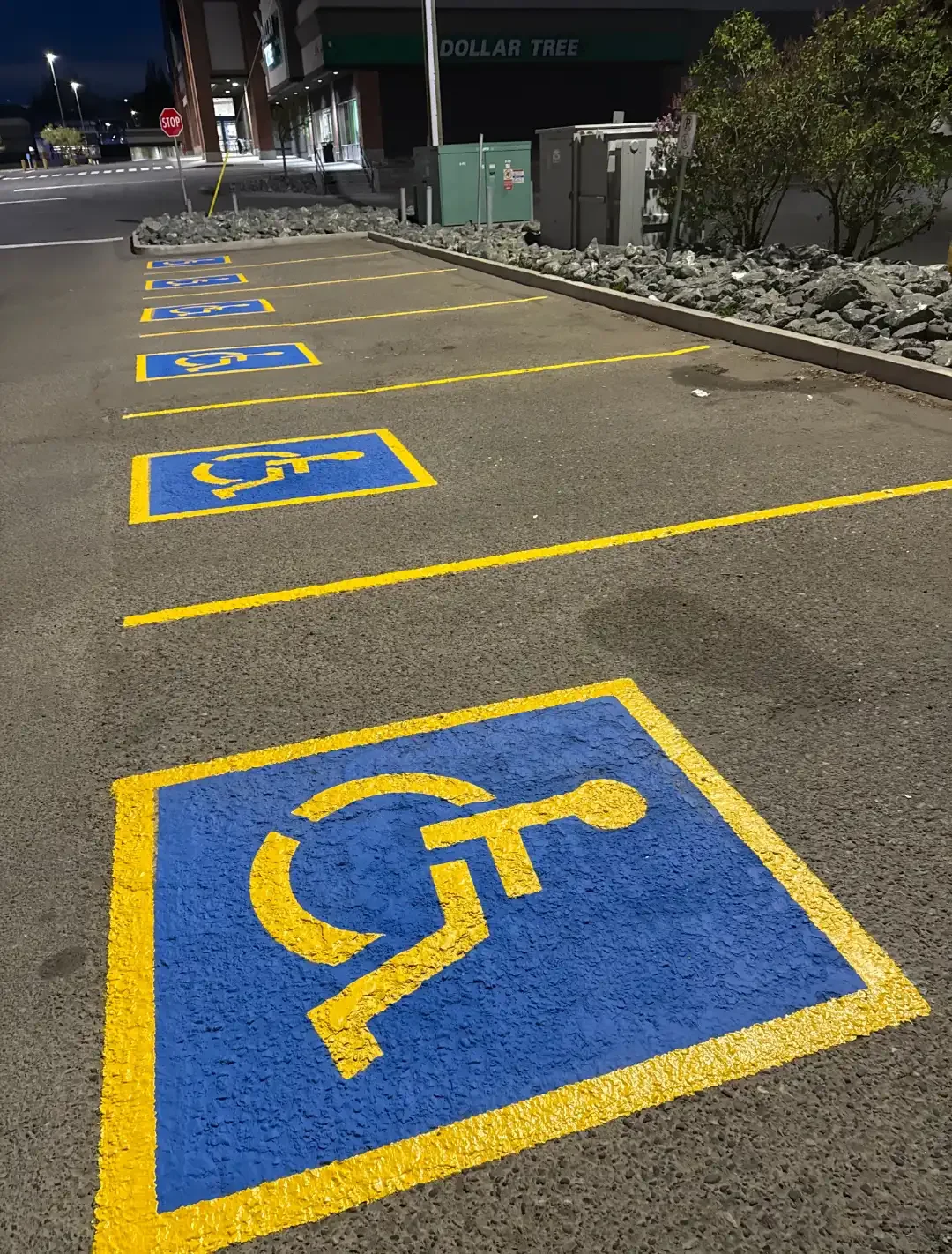
Stencil work is a separate skill. Accessible stall symbols (the International Symbol of Access — wheelchair on blue background), directional arrows, fire lane markings, no-parking zones, numbered stalls, and crosswalks all require stencils and proper paint application. The blue background on accessible stalls is not optional in most BC municipalities — and the symbol has to be painted in the correct orientation, on a contrasting background, with adequate fade resistance. Most "discount" line painting quotes don't include stencil work, or do it badly. Look at your existing markings: if the wheelchair on your accessible stall is faded, off-centre, or facing the wrong direction, that's worth fixing.
Layout review at restriping is free if you ask for it. When we restripe a lot, we don't just paint over what's already there. We look at whether the existing layout is making sense — whether stall counts can be increased without losing usable width, whether traffic flow is creating choke points, whether accessible stalls are appropriately located near the building entrance. A restripe is the moment to fix layout problems while the surface is already in scope.
The two most common mistakes we see on existing lots:
Too few accessible stalls, in the wrong places. Often the only accessible stall is in the corner of the lot, furthest from the building. Local bylaws typically require accessible stalls to be on an accessible path of travel to the entrance.
Faded markings being "refreshed" rather than redone. Painting fresh white over faded white doesn't produce fresh-white visibility — it produces a slightly-less-faded outcome. Properly done, faded markings are mechanically removed (water blasting or grinding) and repainted on clean substrate.
Part 4 — An Honest Look at Sealcoating
Sealcoating — the application of a coal-tar or asphalt-emulsion sealer over an existing asphalt surface — is widely promoted in the asphalt maintenance industry, including by some of our regional competitors. It works well in many climates. It is more marginal in Central and Northern BC.
We're going to give you the honest version of this, because the marginal-case answer is something most contractors won't tell you.
The honest case for sealcoating:
It provides UV protection, which slows oxidation and extends the surface's useful life.
It seals micro-cracks before they open into full cracks.
It gives the lot a uniform jet-black finish, which improves curb appeal and (slightly) helps melt snow faster in spring.
Industry sources widely cite a sealcoating cycle of every 3-4 years as part of a comprehensive maintenance program.
The honest case against sealcoating in our specific climate:
Sealcoating requires sustained surface temperatures above approximately 10°C (50°F) for proper cure, with no rain in the forecast for 24-48 hours and no freezing temperatures for several days after application. The workable window in much of Central and Northern BC is late June through early September — narrow, and narrower in the higher-altitude communities.
Sealcoat does nothing for cracks wider than hairline. If your lot has the wider thermal cracks that our freeze-thaw cycle produces, sealing over them without proper crack sealing first is putting makeup on a problem that's still progressing underneath.
The same freeze-thaw cycle that's the primary deterioration mechanism in this climate damages sealcoat similarly to asphalt — the sealcoat itself develops fine cracks within a season or two of application.
The cost-per-square-metre of sealcoating is meaningful, and on most properties in our region, that same dollar is almost always better spent on crack sealing first.
We don't tell clients sealcoating is wrong. We tell them it's lower-priority than crack sealing in this climate, and on a lot of properties — particularly older lots with established cracking — it doesn't justify the cost. There are properties where sealcoating makes sense: newer lots in good condition with hairline-only surface raveling, properties in the milder coastal communities of the northwest, properties where curb appeal genuinely drives revenue (high-end retail, hospitality). On those properties, we recommend it.
If a contractor is leading their pitch to you with sealcoating before they've talked about crack sealing, that's worth questioning.
Part 5 — Building an Annual Maintenance Program
A real asphalt maintenance program in our region is not a single annual visit. It's a sequence that runs from April to October and tracks the climate.
Late March / early April — site assessment and spring sweep. Snow has cleared. We walk the property, document new cracks, identify any winter-damage potholes, photograph the surface, and map the year's work. The spring sweep removes accumulated winter sand. This is when we also identify which asphalt repairs need to happen and prepare quotes.
April / May — emergency repairs and cold patch where needed. Anything that's a liability hazard right now gets addressed. If air temperatures haven't hit the hot mix workable window yet, we use cold patch as a temporary measure, with the understanding it'll be redone properly later in the season.
Mid-May through August — hot mix repairs, infrared work, line painting. This is the busy window. Permanent repairs happen now, while temperatures support proper compaction. Once repairs are complete and the surface has cured (typically 24-48 hours), line painting can proceed. Sealcoating, where it's part of the program, also happens in this window.
September — final repairs, follow-up sweeping. Catching anything missed earlier in the year. Properties that hosted summer events or had unusual traffic loads often need a mid-season sweep here.
Late September / early October — crack sealing. This is when crack sealing happens. The cracks are at their narrowest summer state, the surface is still warm enough to bond, and the water-blocking benefit of the seal carries the property through the worst of the freeze-thaw season ahead.
Late October — pre-winter sweep. Final cleanup before the snow flies. The property enters winter with a clean, sealed surface and properly-marked traffic flow.
November through March — winter mode. Snow removal takes over as the operational priority. Asphalt maintenance is largely on hold, except for emergency cold patch repairs on potholes that develop mid-winter.
That's the full year. A property running this sequence consistently is a property that's adding 5-10 years to the realistic lifespan of its asphalt compared to a property that's reactive — and is doing it for substantially less money than the eventual reconstruction would cost.
What this looks like as a budget
Most commercial property managers are familiar with capital vs. operating expenses. A useful framing: think of asphalt maintenance as the operating expense that defers the capital expense of reconstruction.
A rough order of magnitude (verify with current local quotes; we're providing this for relative scale, not as a price guide):
Annual maintenance program (spring sweep + summer repairs as needed + fall crack sealing + fall sweep): typically 5-15% of what a full reconstruction of the same lot would cost. Per year.
Repaving / overlay (every 15-20 years on a well-maintained lot): typically 30-50% of full reconstruction cost.
Full reconstruction (only when base failure is widespread): the big one.
The math: 15 years of disciplined annual maintenance plus an overlay at year 15 typically lands well under the cost of a full reconstruction at year 15 on a neglected lot. Plus you get to defer the reconstruction by another 10-15 years. The FHWA's 4-5× cost multiplier shows up here in real numbers.
Part 6 — How to Vet a Pavement Maintenance Contractor
This is probably the single most useful section of this guide for a property owner who doesn't already have a contractor relationship they trust.
Three diagnostic questions
1. Walk me through the maintenance sequence you're recommending and why.
A contractor who can articulate the order in which they'd address your specific property — with reasoning that ties back to climate, current condition, and the priority of crack sealing — is a contractor who's actually thought about your site. A contractor who can only describe their services in isolation, or who treats your lot as identical to every other lot they're quoting, isn't.
2. What's your crack sealing scope and timing?
This is the single most diagnostic question in this trade. A contractor who treats crack sealing as a casual line item — or who's pushing sealcoating before crack sealing — is selling you the four-to-five-times-more-expensive version of the work that should happen first. The right answer involves a fall application window, hot-applied rubberized sealant (not cold-pour filler from a bucket), and a clear scope on which cracks are getting sealed and which need to be cut out as repairs.
3. How are you handling accessible stalls under the local bylaw?
If the answer references the BC Building Code with no awareness of the 2018 change, or if the answer is vague about the specific local requirements for the community where the property is located, that's worth knowing before you sign. Local bylaw compliance on accessible parking is your liability as the property owner, not theirs.
What to look for in a quote
A solid quote should break work out by service, with linear metres or square metres specified for each. If the quote has line items like "general maintenance — $X" with no breakdown, that's not a quote, it's a bill. A few specific things worth checking:
Crack sealing scope. Linear metres of crack to be sealed, type of sealant (hot-applied rubberized polymer-modified is the standard), and timing.
Repair scope. Square metres of repair, depth of repair (surface-level vs. full-depth), method (cold patch, hot mix, infrared), and which areas of the lot are included.
Sweeping. Number of visits and approximate timing.
Line painting. Number of stalls, linear metres of paint lines, number of stencil applications (each accessible symbol counts), and paint type.
Disposal and cleanup. Who's responsible for removed asphalt, accumulated sand, and other debris.
Things that should make you cautious
A quote that's substantially lower than others for the same scope. There's almost always something missing.
A contractor who pushes sealcoating without first discussing crack sealing.
A contractor who can't or won't break a quote into the four service categories.
A contractor who can't articulate why a particular method is right for your specific property.
A contractor who's not aware of the 2018 BC Building Code accessibility change.
A contractor who claims to handle "everything" but only has one piece of equipment visible in their photos. (Different services genuinely require different equipment — crack sealing melters, hot-mix laydown gear, mechanical sweepers, line painting machines, infrared trucks. A real maintenance contractor has multiple.)
Things that should give you confidence
A contractor who walks the property with you before quoting.
A contractor who photographs distresses and includes them in the quote documentation.
A contractor who's honest about what's not worth doing on a particular property.
A contractor who can name specific local bylaw requirements for the community where the property is located.
A contractor who'll defer non-urgent work to the right season rather than doing it now for the invoice.
A Note for Residential Property Owners:
Most of what's above applies, just at a smaller scale.
For a residential driveway, the same priorities hold: crack sealing first, repairs as needed, sweeping in spring. Sealcoating is a closer call for residential than commercial in our climate — the cost-per-square-metre is lower because the surface is smaller, and the aesthetic benefit of a black driveway is more visible than on a commercial lot. We do residential sealcoating where it makes sense.
What's different for residential:
Line painting is rarely an issue unless you're managing a small multi-residential property.
Crack sealing is still the highest-leverage thing you can do — and residential driveways tend to get neglected on this front more than commercial lots, because there's no facilities manager tracking it.
Pothole repair tends to be handled by the homeowner with cold patch. That's fine for the immediate fix, with the understanding it's temporary. If a pothole reappears in the same place year after year, that's a structural issue with the base — not something cold patch will solve.
The Part 2 distress diagnosis still applies. Walk your driveway in spring with the same checklist a commercial property manager would use. Hairline transverse cracks are fine and easy. Alligator cracking near the road edge is not fine and is telling you something about your base.
For most residential properties in our region, the most useful single decision is to put crack sealing on the calendar every September, and walk the surface in early April to see what winter did. Most residential pavement issues here are downstream of skipping those two steps.
How Epic Pavement Works
We're a small, locally-owned operation based in Prince George, serving Central and Northern BC. Our founder, Dennis Kuebler, built the company on a simple principle: do solid work, treat customers well, build something people can rely on. His background as a certified mechanic shapes how we run equipment and how we maintain it through the year — a maintenance program is only as reliable as the gear behind it, and the gear is only as reliable as how it's serviced.
For asphalt maintenance specifically, that means:
We start every commercial relationship with a documented site assessment and a multi-year maintenance plan, not a one-off quote.
We sequence the work to the climate — crack sealing in fall, hot mix repairs in summer, sweeping in spring and again before winter.
We're honest about what's not worth doing on a particular property, including sealcoating when we think the dollars are better spent elsewhere.
We work to the current local bylaws on accessible parking and line painting compliance, for the specific community where the property is located.
And we take care of the small repair before it becomes the big one.
If you're sorting out asphalt maintenance for your property — commercial or residential, anywhere across our region — get in touch. We'll come walk your site, document what we see, and put a real plan in front of you instead of a single repair quote.
Request a free quote at epicpavement.ca, call (250) 617-8289, or email info@epicpavement.ca.
For specific service pages: Asphalt Repair · Parking Lot Sweeping · Parking Lot Line Painting · Snow Removal.
Frequently asked questions
-
A real maintenance program touches the surface multiple times per year: a spring assessment and sweep, hot-mix repairs in the summer window, line painting after repairs, fall crack sealing, and a pre-winter sweep. Crack sealing on a 5-7 year cycle, full repairs as triggered, full reconstruction every 25-30 years if maintenance has been consistent.
-
Crack sealing in early fall. By a wide margin. The FHWA's research on pavement life cycles shows that early-stage maintenance interventions are 4-5× cheaper per unit of pavement condition restored than late-stage interventions. Crack sealing is the early-stage intervention with the highest leverage.
-
You don't need to. In our climate, sealcoating is more marginal than in milder climates — the workable application window is short, freeze-thaw damages the sealcoat similarly to asphalt, and the dollar usually goes further on crack sealing. We do sealcoat properties when it makes sense, and we say so when it doesn't.
-
Cold patch is pre-mixed asphalt material that can be applied at any temperature. It's a temporary fix that lasts roughly 6-12 months on commercial lots before the patch loosens. Hot mix is delivered hot from a plant, requires air temperatures above ~4°C (40°F) to install properly, and produces a permanent repair when applied in proper conditions. We use both — cold patch for emergencies, hot mix for permanent work.
-
Infrared repair heats the existing asphalt around a damaged area, blends in new material, and produces a thermally-bonded repair without a cold joint. It works very well for surface-level issues — raveling, oil-stained spots, levelling around utility covers — but only penetrates 25-50 mm into the surface, so it can't fix structural failures of the base. We use it where it's the right tool, not as a default.
-
An overlay is a new layer of asphalt (typically 25-50 mm) placed over an existing surface after milling and base repairs. It sits between major spot repair and full reconstruction in cost, and it can meaningfully reset the pavement life cycle when the underlying base is still sound. Usually the right call when surface damage has accumulated past spot-repair scale but the base structure is good.
-
Yes, but the regulation is municipal, not provincial, since 2018. The 2018 BC Building Code change eliminated province-wide accessible parking requirements; local zoning bylaws now set the rules. Each community's bylaw is different — Prince George governs through Zoning Bylaw No. 7850, but Quesnel, Vanderhoof, Smithers, and other communities have their own. Any contractor restriping your lot should be working to the bylaw applicable to your specific community.
-
The most important sweep is the post-winter spring cleanup, ideally late March to mid-April once snow has fully cleared. A second sweep mid-summer for high-traffic sites is helpful, and a final pre-winter sweep in October enters the property into winter with a clean surface. Local restrictions can apply during air quality advisories — in Prince George, the Clean Air Bylaw prohibits sweeping during active advisories without authorization. Other communities are similar.
-
With a consistent maintenance program — crack sealing on cycle, repairs as triggered, sweeping multiple times per year — 25-30 years is realistic in our climate. Without maintenance, the same lot might be in serious condition by year 15. The maintenance investment is materially smaller than the difference between those two timelines.
-
The clearest indicator is alligator cracking. Hairline cracks, transverse cracks, and surface raveling are surface-level. Alligator cracking, deep rutting, and recurring potholes in the same spot are structural — they tell you the base layer underneath is failing, not just the asphalt above it. Surface-level issues respond to crack sealing and repairs. Structural issues need full-depth intervention.
Sources & Further Reading
For property owners and managers who want to dig further into the technical and regulatory references in this guide:
Pavement engineering and economics
Pavement Interactive — Pavement Life Cycle — the industry's authoritative reference on pavement deterioration and maintenance economics, developed by the Pavement Tools Consortium (state DOTs, U.S. Federal Highway Administration, and University of Washington). Source for the 75% / 17% deterioration curve and the 4-5× cost multiplier on deferred maintenance.
Federal Highway Administration — Stevens, Road Surface Management for Local Governments (1985, Publication DOT-I-85-37) — the original FHWA source for the pavement life cycle research.
BC Ministry of Transportation — Pavement Structure Design Guidelines (Technical Circular T-01/15) — the provincial reference for pavement design and rehabilitation standards.
BC Standard Specifications for Highway Construction (2025) — provincial specifications referenced by most municipal infrastructure standards in BC.
Provincial and local regulations
Province of BC — Building Codes and Standards — current BC Building Code, including the 2018 update that affected accessibility parking requirements.
City of Prince George — Zoning Bylaw No. 7850 — local accessibility, parking, and zoning requirements for property in Prince George.
City of Prince George — Property Maintenance Bylaw No. 8425 (PDF) — covers property maintenance obligations including snow and ice removal.
City of Prince George — Bylaws library — Clean Air Bylaw and other regulations affecting commercial property operations.
Other regional municipal bylaws — your local jurisdiction's Zoning Bylaw and Property Maintenance Bylaw set the rules for your property. Check your municipality's website or contact local bylaw services.
Air quality and regional environmental context
Prince George Air Improvement Roundtable (PGAIR) — multi-stakeholder body addressing air quality in the Prince George airshed, including the role of road dust and street sanding residue.
BC Air Quality Warnings — current and historical air quality advisories for Prince George and other BC communities.
BC Air Quality Health Index — Prince George — Environment Canada's real-time AQHI for the region.
Workplace safety and liability
WorkSafeBC — Slips, trips, and falls — provincial data on the cost and frequency of slip-and-fall workplace claims in BC. Relevant context for any commercial property's maintenance liability calculus.
Industry standards bodies
Transportation Association of Canada (TAC) — Canadian transportation engineering body. The Manual of Uniform Traffic Control Devices for Canada (MUTCDC), which TAC publishes, sets the standard for traffic markings and signage referenced by most municipal bylaws across BC.
Asphalt Institute — international asphalt industry technical authority.
Other Insights From Us