
Project Highlight: Christmas Day Snow Plowing and Sanding at Tabor Estates, Prince George, BC
By Dennis Kuebler, Founder & Owner, Epic Pavement

Project Snapshot
Project: Heavy snowfall response — full-lot plowing, windrow management, and traction sanding at a 42-unit residential strata complex
Location: Tabor Estates, 101 Tabor Blvd N, Prince George, BC
Completed: Christmas Day, 2025
Scope: Plowing of all drive aisles, visitor parking, and accessible routes; snow stacked into designated piles; full traction sand application across plowed surfaces, building entrances, and walkways
Conditions: Heavy overnight accumulation, sub-zero temperatures, short-staffed holiday crew, lot full of parked resident vehicles — many that hadn't been moved before the storm
Equipment: Wheel loader with snow bucket, broadcast sand spreader, hand tools for tight zones
Epic Pavement is a Prince George, BC-based pavement marking and asphalt maintenance company serving Central and Northern British Columbia. Founded by Dennis Kuebler in 2023, we focus on parking lot line painting, line striping, accessibility markings, asphalt repair, crack filling, parking lot sweeping, and snow removal for commercial, industrial, and residential properties — including a number of multi-tenant strata complexes across Prince George.
Christmas morning in Prince George usually has a particular feel to it. The city is quiet. The roads are empty. Most people are inside with family, the lights are on, and the only sound outside is the snow coming down. That's beautiful if you're sitting on the couch with a coffee. It's a different kind of beautiful when you're the snow removal contractor and your phone is going off because the storm is still dumping and the strata you service can't wait until Boxing Day. That was the morning at Tabor Estates. A 42-unit residential strata on Tabor Blvd N, two storeys, built in 1981, with a population that needs to get to vehicles, walkways that need to stay clear, and visitor parking that fills up over the holidays. Snow had piled up overnight, the lot was full of parked cars that hadn't been moved, and our crew was short on bodies because of the day.
We took the wheel loader, the sand spreader, and a couple of shovels, and we plowed the property anyway. This is the story of how that job went and what made it different from a normal snow push.

I've plowed a lot of properties. Retail lots before opening. Office complexes before the morning rush. Industrial yards where the operator just needs the gates clear. Each one has its own pattern. A residential strata is its own animal, and a residential strata on Christmas Day is something else again.
A few things make this job different from a standard commercial push:
The lot stays full. On a retail lot you can usually plow before the doors open, when the property is empty and you can run a clean push all the way to the curb. At a residential strata, people are home. Their cars are parked. And on Christmas, those cars are really parked — half the residents are away for the day at family or have guests over, and nobody is moving anything for the contractor. You plow around the cars or you don't plow at all.
Visitor and guest parking is at peak. Christmas means out-of-town family staying with residents, holiday hosting, kids home from university. The visitor stalls are often as full as the assigned ones, and there's usually a couple of unfamiliar vehicles tucked into spots that aren't normally used. We don't know which car belongs to whom, and we don't get to wake anyone up to ask.
The residents need access, but they need it gently. The lot still has to be cleared — for emergency access, for residents who do need to leave for the day, and to prevent the snow from compacting into ice underneath all those vehicles. But "cleared" can't mean "berm pushed onto someone's quarter panel."
Holiday staffing is thin everywhere. Most contractors quietly skip Christmas. The ones that don't are running short crews and stretched routes. That's exactly why strata corporations sign winter contracts in October — so they know somebody is showing up on December 25.
You are still working in deep cold. Prince George Christmas mornings can be ‑20 °C or colder. Hydraulic fluid thickens, batteries struggle, and the operator has to manage real exposure on any task that puts them outside the cab. That changes the pace.
When a strata council calls me about winter service and asks what we do differently from a residential side-yard plow guy, this job is what I describe. It's the same equipment in a sense — but it is not the same job.
Why a Residential Strata on a Holiday Is a Different Kind of Snow Job
Reading the Site Before the Loader Moves
Before I drop the bucket on a residential complex, I walk it. On a property the size of Tabor Estates — 42 units, two storeys, two main drive aisles, visitor stalls, assigned parking, and walkways to each unit door — that walk is the difference between a clean job and a wrecked fender.
Where every parked car is. I do a mental inventory before any blade moves. Which cars are parked tight to the painted line, which are an inch over, which are angled into a stall instead of straight. Sedans, trucks, SUVs, the one car that hasn't been moved since the last storm and now has a foot of snow on the roof. I note them all.
Curb stops, signage, and bollards. These get buried fast and they're brutal on equipment if you hit them at speed. On a strata that's been around since 1981, some of the concrete curb stops have been knocked loose over the years and are sitting in positions you can't predict from the layout. I find them now, not the hard way.
Sightlines at the entrance. Where residents pull in off Tabor Blvd N, where the visitor lane intersects the drive aisle, where a parent is going to walk a kid across to the car. Those zones get cleared first and sanded heaviest.
Snow pile destinations. This is the planning question on every multi-unit residential property: where does the snow go? Strata lots are tight. You can't just push everything to the perimeter — you'll bury landscaping, block accessibility ramps, or pile against unit windows. We have designated stacking zones — usually corner areas at the back of visitor parking where the pile won't block sightlines, won't blow into walkways as it drifts, and can be hauled out later if it gets too big.
Walkways and unit entries. Every unit has a path to a door. Those have to stay walkable, and they're typically beyond the reach of a wheel loader bucket. We plan which ones get shovel-cleared and in what order.
That walk-around takes maybe fifteen minutes. It's the part nobody sees, and it's the part that decides whether the property gets a clean push or a property manager call on December 26.
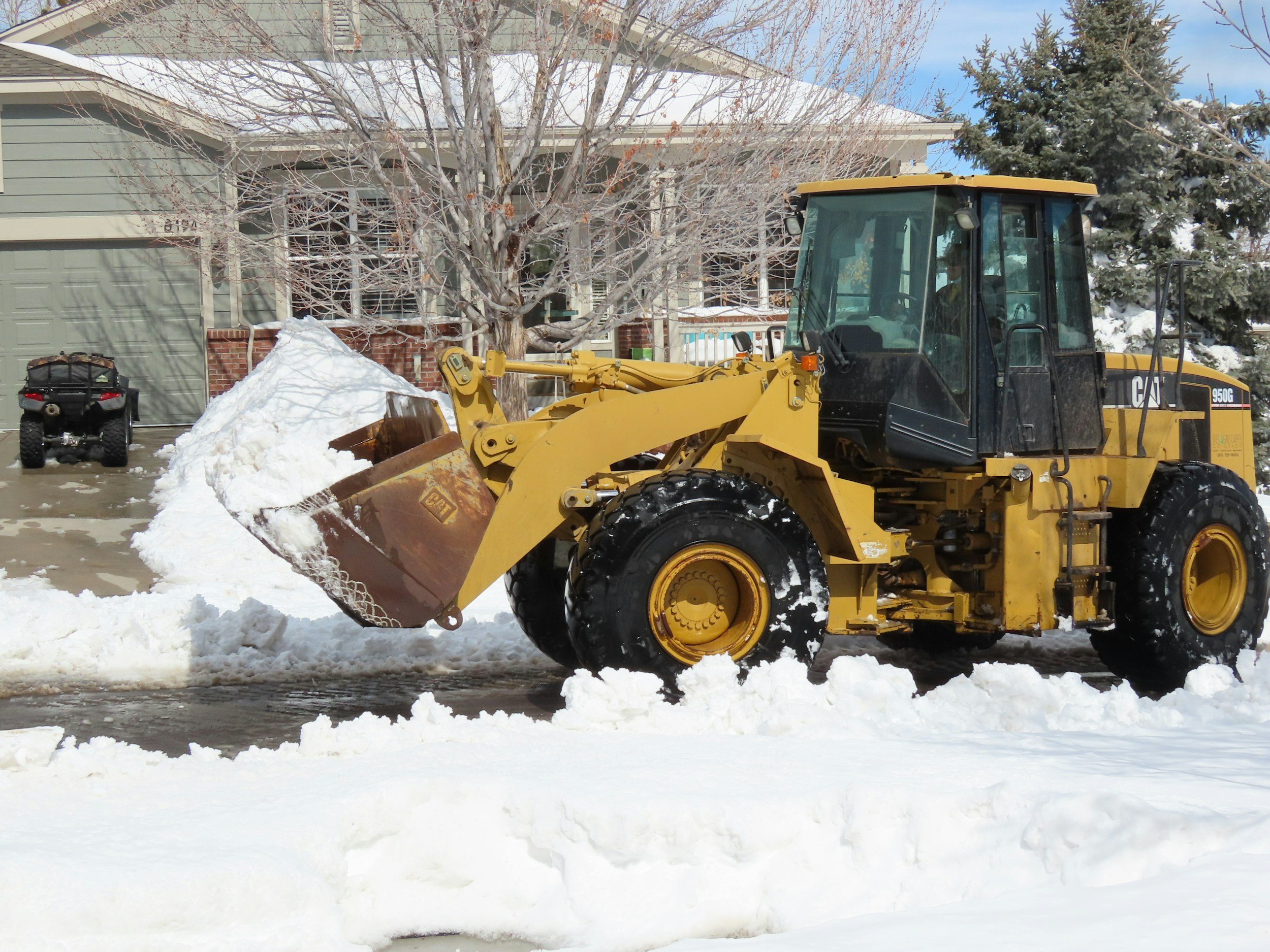
Why We Ran the Wheel Loader, Not the Skid Steer
Our usual go-to on commercial lots is a Kubota skid steer with a snow pusher — the right size for tight Prince George commercial lots and most residential drives. For Tabor Estates on a heavy Christmas dump, we scaled up to a wheel loader, and that decision was made before we ever left the yard. Here's why it was the right call:
Snow volume. This was a real accumulation — not a polite three-inch top-up. With that much snow over a 42-unit lot, the skid steer would have made the property eventually, but slowly. A wheel loader carries a much bigger bucket — typically 1.5 to 2.5 cubic yards versus roughly half a yard on a skid steer — and clears each pass at a much wider width. On a short-staffed Christmas Day where speed matters, that's not a luxury, it's the job.
Stacking height. Wheel loaders lift higher than skid steers. When the snow piles at the back of the lot started building up, the loader could stack snow vertically into a pile that wouldn't immediately spread back into the parking stalls. A skid steer tops out lower, and on a property where pile space is limited, that matters.
Operator visibility. The wheel loader cab sits higher off the ground than a skid steer. That sounds counterintuitive — you'd think a smaller machine would be safer around parked cars — but the higher cab gives the operator a much better view over parked vehicles, sightlines down rows, and into corners. Around 40-plus parked cars on a holiday, that visibility is a safety feature.
Stability on hardpack and ice. A wheel loader's weight and footprint handles slick conditions better than a smaller machine. On a steep section of the lot or a glassed-over corner, you want the bigger machine.
The reason this matters for property managers reading this is that a snow removal contractor should be picking equipment to fit the storm and the lot, not running one machine for everything. Anyone who tries to plow a heavy-snow strata with a small skid steer is going to be there all day and will probably damage a curb on the way out.
The Plowing and Sanding Method
For a residential strata like Tabor Estates, the work falls into a sequence that's repeatable on every visit. On a Christmas Day push, that sequence still runs — it just runs with extra care on the car-adjacent passes.
1. Open the entrance first. The first pass clears the entry off Tabor Blvd N so emergency vehicles, residents leaving for the day, and the loader itself have a clean way in and out. This pass also opens the main drive aisle so we have somewhere to push snow toward as we work the rest of the lot.
2. Drive aisles, working outward. From the main aisle, we plow each branch and connecting lane. The bucket carries snow toward the designated pile zones — not into resident vehicles, not into landscape edges, and not into walkways.
3. Visitor and unassigned stalls before assigned ones. Where stalls are empty, we clear them down to the painted line. Where stalls are full of parked cars, we plow the open lane in front of the cars and leave a windrow at the nose of the vehicle that can be pushed later when the resident moves (or that the resident can knock out with a shovel without a big lift). The point is: clear what we can, and don't push snow up against a vehicle.
4. Pile management. Snow gets carried to the designated stacking zone and built up into a single tidy pile rather than several sprawling ones. Sprawling piles eat parking stalls; tall pile-builds preserve them. On a property that may need snow hauling later in the season, a centralized pile is also much easier to load out.
5. Walkways and unit entries. Hand shovels and a smaller snow blower handle the paths to unit doors, garbage and recycling enclosures, mailbox banks, and any accessibility ramps. These can't be reached cleanly with a wheel loader bucket, and they have to be done by hand. On Christmas Day specifically, these are the routes residents are most likely to use — out to the car, out to put recycling out, in from a guest's vehicle — so they matter even more than usual.
6. Sanding. Once plowing is complete, a broadcast traction sand spreader runs over the cleared drive aisles, stalls, and walkways. Sand goes heaviest at: the entrance off Tabor Blvd N (where vehicles transition from sanded city road onto strata pavement), drive aisle intersections (where vehicles are most likely to need to stop or change direction), building entrances and walkway approaches (where pedestrians are most likely to slip), and any sloped sections of the lot where ice forms first.
A note on sand versus salt at Tabor Estates. Christmas Day in Prince George is well past the temperature where salt is effective — once you're below roughly ‑12 °C, salt loses most of its melting power. The City of Prince George uses traction sand on its roads for exactly this reason. We use sand for the same reason: it works at any temperature, and on a residential strata where pets are walking through the lot, sand is also less hard on paws than salt residue can be.
Working Around 40-Plus Parked Cars
This was the operational challenge of the day, and it's the one I want to be specific about, because anyone who's hired a "snow guy" before knows this is where most damage happens.
A wheel loader has a wide bucket. The reach of that bucket is at least eight to nine feet across the front of the machine, and that bucket is heavy. Catching a fender at even walking-speed will leave a real dent. So a few things on every pass:
Slow down on car-adjacent rows. The drive aisles between parked cars get plowed at a speed where if something looks wrong — a mirror folded in tighter than expected, a bumper protruding further than the painted line — there's time to stop. This is slower than a normal commercial push and that's the right speed.
Plow with the cars, not against them. Where we can, we run the bucket parallel to the painted line and push the snow down the open lane. We don't drive at right angles toward a row of vehicles. The forces of the bucket point away from cars, not toward them.
Stop short of windrowing into vehicles. If a stall is full and the natural plow line would windrow snow up against the parked car's tires or door panels, we stop short of the stall, lift, and reposition. It takes longer. It's the only way to plow a full residential lot without leaving someone a Christmas present they didn't want.
Use shovels for the awkward spots. A few stalls every storm have a vehicle parked at an angle, or a vehicle so close to a neighbour that the bucket can't fit between cleanly. Those stalls get a hand-shovel pass rather than a forced push. The math is simple: a shovel pass is five minutes; a damaged car claim is a much bigger problem.
Document the property when you arrive. On a job like this, I do a walk with my phone and shoot photos of the lot before we start work. Any existing damage on resident vehicles — a dent on a quarter panel, a scrape on a bumper — is photographed and timestamped. That protects the strata, the resident, and Epic Pavement equally if a question comes up later.
This is the part of strata snow removal that takes a different mindset than commercial parking lot work. The lot belongs to the residents, and so do the cars in it. Plow it like you'd plow your own building.
What the Finished Lot Looked Like
When we pulled the loader off the property and packed up, Tabor Estates had: Drive aisles cleared and sanded for two-way traffic and emergency vehicle access. Visitor parking and empty assigned stalls plowed down to the painted line. Stalls with parked vehicles plowed in front and beside the car, with any remaining snow left as a manageable windrow at the nose rather than pushed against the vehicle. Snow stacked tidy at the designated rear pile location, ready for hauling if the season called for it. Walkways to every unit door, the recycling enclosure, the mailbox bank, and the accessibility routes — hand-cleared and sanded. Building entrances sanded for traction.
Why We Took This Job Personally
Epic Pavement is a small operation. I founded the company in Prince George in 2023 with the goal of doing solid work, treating customers well, and building something my family could be proud of.
A push like Christmas at Tabor Estates mattered to me for a few reasons:
It's a strata, and strata residents are real people. A retail lot can wait until the doors open. A strata is somebody's home. Forty-two units of households, kids, pets, elderly residents — they all need their property to function on the worst-weather day of the year as much as any other day. A contractor who skips Christmas is telling those residents that their property is lower priority than the contractor's day off. That's not what we signed up for in October when we took the contract.
It's the kind of job that decides whether a strata renews. Strata councils take snow removal seriously. They're paying for it through every owner's monthly maintenance fees, and the council members hear about it directly when it goes wrong. A contractor who shows up on Christmas is the contractor who keeps the account next October.
Short-staffed and long days are part of the trade. A small business takes the days nobody wants. That's part of why you choose to do work like this — and part of why, when the property runs cleanly through the season, it actually means something.
Prince George winters are real. This isn't Vancouver. The snow shows up and stays for months, the cold sits below ‑15 °C for stretches, and properties either function through it or they don't. Doing this work well, on the worst days of the year, is how a snow removal company earns its place in PG.
Need Snow Plowing, Sanding, or Hauling for a Strata, Commercial Lot, or Residential Property in Prince George?
Get a free quote:
📞 Call us direct: (250) 617-8289 ✉️ Email Dennis: info@epicpavement.ca 🌐 Request a quote online
FAQs
-
A property the size of Tabor Estates with a wheel loader and a one- or two-person crew is typically a few hours from arrival to packed up — plowing, pile-building, hand-shovelling unit entries, and broadcast sanding included. Heavier accumulations and short-staffed conditions take longer. Lighter top-up pushes go faster.
-
Yes. Snow removal contracts at Epic Pavement run from first snow to last regardless of date or holiday. Storms don't take days off, so we don't either. Holiday and overnight pushes are part of the strata and commercial contracts we take on.
-
For lighter snowfalls and tighter properties, a skid steer is the right machine. For a 42-unit complex on a heavy-snow day with limited pile space and a short-staffed crew, a wheel loader carries a much bigger bucket, stacks snow higher, and clears the property significantly faster. We pick the machine to fit the storm and the lot, not the other way around.
-
A walk-around inventory of every parked vehicle before the bucket moves, plowing parallel to painted lines instead of perpendicular toward cars, stopping short of windrowing snow into vehicles, hand-shovelling tight spots that the bucket can't fit cleanly into, and photographing the lot on arrival in case a question comes up later. We treat the residents' vehicles the way we'd want ours treated.
-
Yes. Recurring winter contracts for strata complexes are one of the customer types we work with regularly. Most strata accounts run as a seasonal flat-rate contract — set winter price, automatic plowing once accumulation crosses the agreed trigger depth, sanding bundled in, and hauling priced separately or included depending on the property.
-
Salt loses most of its effectiveness below roughly ‑12 °C, and Prince George winters spend a lot of time below that line. Traction sand keeps working at any temperature, which is why the City of Prince George uses sand on its roads. Sand is also gentler on pets walking through the lot than salt residue can be, which matters on a residential property.
-
Yes. Epic Pavement carries commercial liability insurance and is in good standing with WorkSafeBC. Certificate of Insurance and clearance letters are available on request, which is standard for strata corporations and commercial property managers before service begins.